The flora of Périgord in South-West France is abundant and diverse. In this blog you can find, in pictures, brief encounters with several hundreds of wild flowers and plants as they grow here in French Perigord. Following the seasons other species are added. An index of scientific and English names you find below on the right.

Corine Oosterlee is a botanist and photographer and she offers guided Botanical Walks and other activities around plants and vegetation in nature in Perigord. Do you want to know more? On www.baladebotanique.fr you can find more information. For Corine's photography see www.corineoosterlee.com. Both websites also in English.

Enjoy!


July 16, 2023

Cantabria Morning Glory


It is not any longer in flower now. On its branched stems only small fruits can be found.


But two months ago Cantabria Morning Glory (Convolvulus cantabrica) was in flower everywhere on dry stony limestone slopes.


This meadow is scattered with its pink flowers between the flowering ears of Somerset Hair-grass (Koeleria vallesiana) and other typical plants of this habitat. It was May, everything was still green, the plants did profit from the humidity of the early season to grow and flower.


Cantabria Morning Glory has pink pentagonal flowers on stalks more or less prostrate. In contrast with  other Morning Glories this one does not climb.


Its leaves are long and undulated and a bit downy. And the flowers close at night, early in the morning they are not yet open.


Yes!

July 7, 2023

Italian Lords-and-Ladies

Two months ago this bizarre flower could still be found everywhere in woodlands and under trees. Maybe the inflorescence of Italian Lords-and-Ladies (Arum italicum) is not especially beautiful, but it serves its purpose very well.

The spathe, this large whitish bract, contains in its inferior part minuscule flowers well hidden from view. Only a kind of yellow club is visible, it attracts tiny flies.


Those flies enter into the lower part of the spathe where they find odorousand  tasteful pollen-grains. That the smells are good may compensate for the fact that they are prisoners now, the entrance is blocked by reverse hairs so they can't climb out. Only after pollination those hairs dry out and the flies are free to leave and fly around in search of a new spathe-trap.

The result of this special trick:  berries. 


Now, in July, they are still green or just a bit orangy. The pale tuberous ring below them is the remnant of the spathe that has fallen off a few weeks ago.


Soon the berries will turn into a very attractive red. And as an extra, they are sweet! Take care, they are poisonous for us (but there are birds that can eat them without problems and sometimes also roe deer and small rodents).


Only at the end of winter and early spring the attractively white-veined and speckled leaves can be found; they disappear when the flower spathes come out. It is a perennial plant, an underground root system survives.


Italian Lords-and-Ladies leaves withoput spots also exist, they are small and belong to young plants of the year.

March 24, 2023

Daffodil


This flower that shows us its trumpet is a Daffodil (Narcissus pseudonarcissus). Its white tepals are nearly gone. Is it alone? 


Surely not, Daffodils mosty grow in large groups and here, on top of a cliff, everywhere on the forest floor you see its long green leaves.


Most Daffodil bulbs only produce leaves. Only after some years and in favorable circumstances they will carry flowers. Many of those bulbs will never flower. Daffodils grow from seed but also from small bulbs that develop on older plants. Thus, in tens or maybe even hundreds of years, they can cover a large surface.


Daffodils like humus and places with light shadow and not too dry soil. Here they grow high up a steep slope, out of reach from those who want to pick the flowers. In Dordogne, Daffodils are rare and they are so beautiful people like to get the bulbs for their garden, but here, they survive..

This group on the edge of the cliff risks to loos equilibrium and to fall down. Indeed, below some plants grow, even if they don't flower. Maybe the result of earlier falls.


The wild Daffodil is at the origin of many cultivars, sometime after hybridization with other Narcissus. But those plants here are really wild. They are smaller that garden Daffodils and yellow and white instead of yellow.


The microclimat makes a difference, in the place high up there are clearly more plants still flowering. More sun, less wind, more shade from the rocks?

March 8, 2023

Grey Willow


Those branches are somewhat ridged, if you remove the bark you can see that the wood is striated. This is typical for the Grey Willow (Salix atrocinerea). Often it is difficult to distinguish the different Willow species, still more so because they easily form hybrids. In Dordogne, Grey Willow is the commonest species.


This big bush or small tree grows nearly everywhere in places where it is wet enough during a large part of the year.


Here an old specimen on the edge of a pond. It has finished flowering before the new leaves appear, and now the male catkins that lost their pollen have fallen and now float on the water surface. The Salicaceae (Willow and Poplar family) are all dioeciousc. This means they have flowers with only pistils or only stamens, never both of them, and on every individual plant you find only pistillate or only staminate flowers, never both of them.


The catkins are downy, maybe that's why they are called 'catkins', But when they are in full bloom you don't see the downy hairs, the long filaments of the stamens topped with yellow pollen are longer than the hairs. In every catkin there are dozens of flowers, each with two stamens.


The female catkins here are growing and turning from grey to green, they begin to open up. As woth male catkins there are dozens of flowersin each catkin. Every flower bears a gourd-like structure that ends in a yellow tip. This is the carpel that later on will carry the seed with its yellow pistils.


Some long-awaited raindrops don't do much harm. A leaf of last year has not fallen, in Grey Willow it is more oval than long.


October 23, 2022

European Umbrella Milkwort


We are at the end of october but when you look at this field you could think it is May, so many flowers!

Most of them are species that flower as well before as after the drought and hotness of summer, and the little bit of rain that has fallen since then is enough for them to flower. The clovers grown here for fodder are definitely a minority.


In this field on sandy soil on the edge of a Sweet Chestnut forest a small flower with unusual colours is very obvious.


European Umbrella Milkword (Tolpis umbellata) is an Asteraceae. In its flower heads we see pale yellow radiating flowers around a dark red heart.


Every ligulate flower has only one petal fringed at its end. The exterior ligulate flowers are much larger than the lemon yellow and red interior ones. The pistils are nearly invisible in the picture, they are hidden in the flowers. Only some small spots of yellow pollen are visible.


The flowers in the flower head are surrounded by bracts that have all the same length and are covered by grey felt hairs. A second row of longer and irregular bracts form a kind of crown under the flower head. A bit lower on the stem also some bract-like leaves can be seen.


European Umbrella Milkwort is a mediterranean plant and it is not often found in Dordogne, it is at the limit of its area. You could think that with climate change it could become more common here. That's not sure at all, to flourish it needs agricultural fields on sandy soil without herbicide and fertilizer. And this type of habitat is disappearing in Dordogne.


October 20, 2022

Annual Ragweed


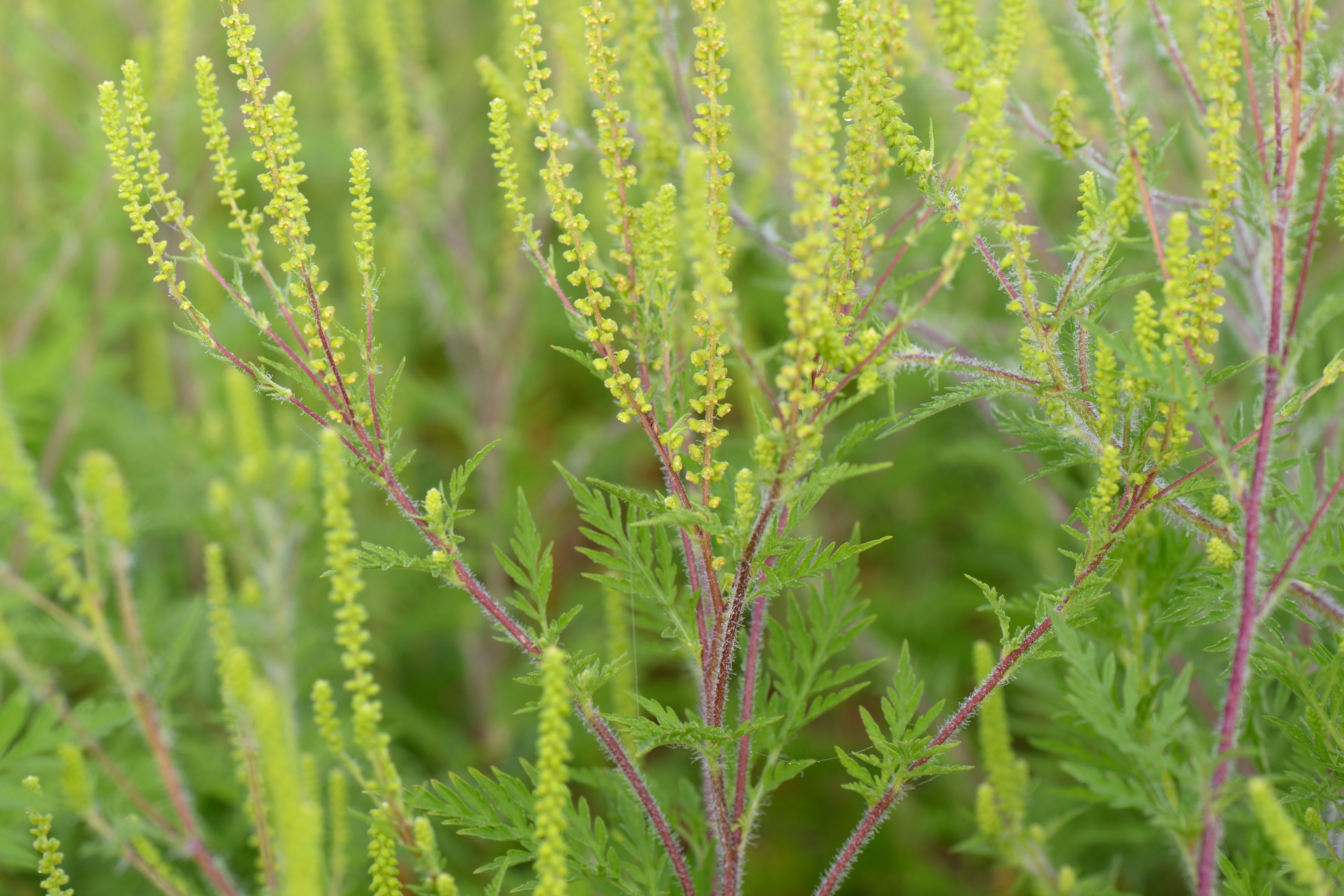
It is a beautiful plant, Annual Ragweed (Ambrosia artemisiifolia). It comes from the Americas and it feels at home in France. A bit too much, you could possibly say. Some years ago it was nowhere to be seen, and now it is everywhere.


It grows upright like a small Xmas tree with many branches, and every branch carries a lot of flowers.


The red colour of those branches nicely contrasts with the tender green of the fern-like leaves and the tiny pale flowers.


It is a monoic plant, which means it has flowers with pollen and flowers with pistils but no flowers with both. Here above the male flowers just begin to loose the yellow pollen. Some female flowers with long white protruding pistils are also visible. The pollen is dispersed with the wind.


It is an annual plant that can form large colonies. Her grows Annual Ragweed in a cereal field after harvest. The seeds have germinated in spring and began to grow somewhat later than the cereals. When the combine harvester passed the little plants were too small to be damaged by it. After harvest there was no longer any competition from the cereals and they could grow fast and big.


In Septembre the field turned yellow, not because of the hot and dry weather but because of a herbicide treatment the farmer put in place to get rid of weeds. It worked very well, there are not many plants alive anymore on the field. With one exception: Annual Ragweed plants are still green and producing a lot of seeds.

If coming spring the circumstances are favorable, those grains will germinate. They need a well-worked soil with only little competition from other plants. The farmer will do what he can to achieve this. He already killed other plants, and with his next passage with tractor and harrow he will break up the soil. Thus a good seed bed will be prepared. Ar the same time he will scatter the seeds, not only in this field but also elsewhere in other fields. This is very effective because modern tractors do much more kilometers a day as those of our grand-parents. A good crop of Annuel Ragweed is almost guaranteed.

Di farmers really want to cultivate Annual Ragweed? Of course not, this plant is not useful for them and unedible for humans or animals. Its pollen is allergenic and a single plant can produce a lot of it. In a few years, Annual Ragweed can cover a large surface and thus prevent other, more desirable, plants to grow. It is not sensitive to frost nor to drought and it can survive under many circumstances. In short it is a nuisance for the farmer. Moreover, there is a legal obligation to destroy it and do do what one can to eradicate it.

Is it possible to eradicate it? Maybe, but then farmers really need to dedicate themselves to the task. Chemical destruction is difficult - Annual ragweed is resistant to many weedkillers - and only useful when done at the right moment, before the plant begins to produce seeds. The same for mechanical destruction by mowing or crushing that should be repeated often to avoid re-growth. To grow a perennial crop that covers the soil as alfalfa or clover can help but then there are no cereals or corn.

Is it advisable to eradicate it? In any case there will be a lot of collateral damage. While destroing Annual Ragweed you also destroy other species living in the fields. Plants, among which rare species that need a specific habitat, insects, soil species and all life that depends on them. There is a reason why the number of swallows is going down so fast! Also, it happens rarely we manage to eradicate an invasive species even if we really do our best. To mention a few well-known exemples: There are still rabbits in Australia and Asian hornets are still in expansion in France. Same story for Japanese Knotweed or Water Primrose, to mention some plants. There is no reason at all to assume it would be different for Annual Ragweed.

A real conundrum.

What to do (or not to do) with Annual Ragweed and other exotic and invasive plants?

Good question...


August 18, 2022

Thornapple

In this arable field  grew about 130 different species of spontaneous plants. Mostly those 'weeds' were messicoles, plants with a life cycle adapted to cereals. Most of them were small or very small, nearly invisible between the triticale stalks.

Now everything has changed. Some years ago the tenancy has been taken over and the new tenant and this farmer uses different techniques. As a consequence the weeds have changed also. The smaller messicoles are gone and other species appeared, big vigourous plants that occupy a lot of space. There are only about thirty different species now, but those are present in large amounts. They are very competitive annual plants that grow fast when there is a lot of nitrogen in the soil, and they multiply quickly. They profit from circumstances fit for corn or sunflowers or another row crop where a lot of fertilizer is used. Because those weeds are less sensitive as other spontaneaous plants to herbicides or fungicides they can survive for a long time even in intensively treated fields.


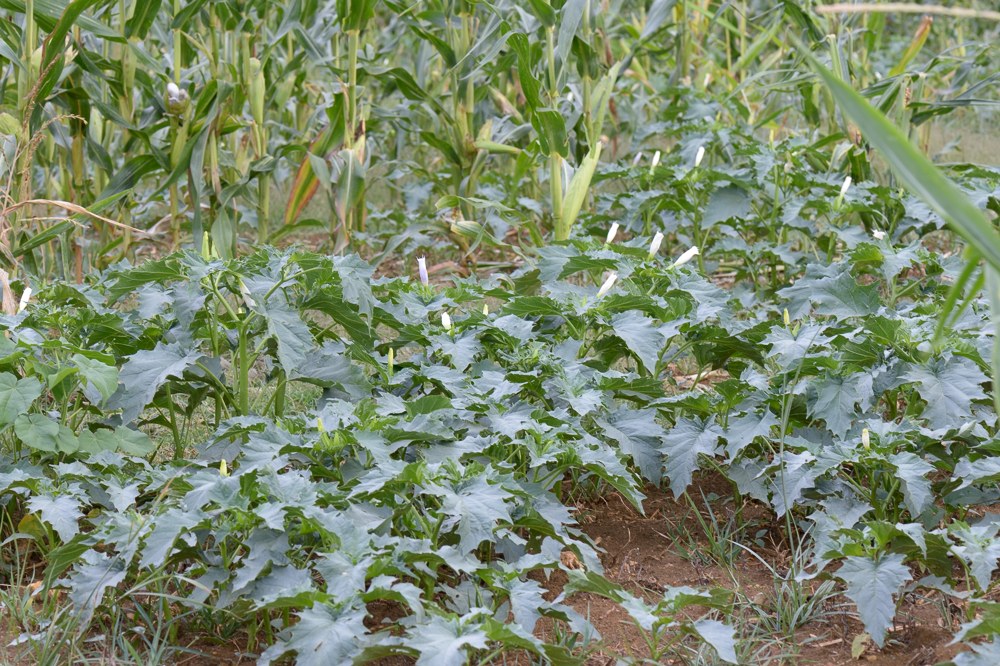
A beautiful exemplar of Thornapple (Datura stramonium) grows here. A small plant newly germed when the triticale was still  growing, became after harvest in just a few weeks a big plant.


Here a colony in a corn field. Thornapple is part of the Nightshade (Solanaceae) family, and like many other Nightshades ot is very poisonous and farmers don't like to have it in their fields. But it is not easy to get rid of it.


The big flowers open only in the daytime. They are trumpet-shaped with pointed leaves, very decorative.


Also the spiny fruits are decorative. They contain many black seeds that easily disperse and germinate. Everywhere, not only in cultivated fields but also in ruderal spots.


At the end of the season most of its leaves have fallen and only the skeletal branches are left. Surely a tractor brought the seeds, in the mud on its wheels or in its wagon with rubble and sand.