The flora of Périgord in South-West France is abundant and diverse. In this blog you can find, in pictures, brief encounters with several hundreds of wild flowers and plants as they grow here in French Perigord. Following the seasons other species are added. An index of scientific and English names you find below on the right.

Corine Oosterlee is a botanist and photographer and she offers guided Botanical Walks and other activities around plants and vegetation in nature in Perigord. Do you want to know more? On www.baladebotanique.fr you can find more information. For Corine's photography see www.corineoosterlee.com. Both websites also in English.

Enjoy!


July 19, 2014

Common Andryala


In this cereal field grow many wild flowers.


In this corner the orange poppies jump to the eye, and also a mass of yellow flower heads. Two plants that like ruderalized spots, like this field that has been laboured but that has not been tidied up since.


The plant with yellow flowers is the Common Andryala (Andryala integrifolia). It flowers through summer with many lemon-coloured flower heads.
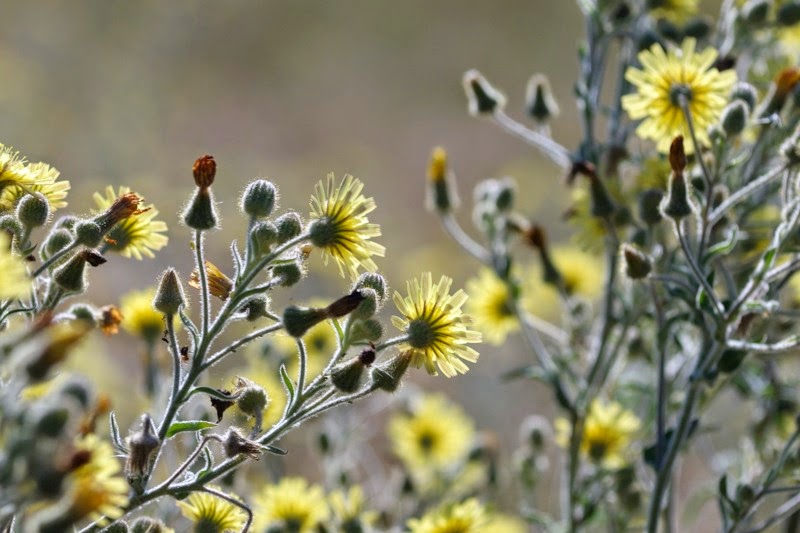


Stalks and leaves are covered with felt-like hairs.


July 2, 2014

Single Yellow-head


Normally it is not a single flowerhead you find where the Single Yellow-head (Inula montana) grows. It is a quite conspicuous plant with its luminous yellow flowers.


Even this year, when the grass in the calcareous meadows that are its favourite spot, has grown quite high and dense.


Its stems and leaves are covered in grey hairs that give them a velvety look.

June 22, 2014

Greater Butterfly Orchid


If you want to see this beautiful orchid in flower, you'll have to hurry. The flowering period of the Greater Butterfly Orchid (Platanthera chlorantha) is nearly over.


Here is one, maybe the last of this year, hidden between grasses.


June 21, 2014

Carrot Burr-Parsley


A cultivated field on poor and stony soil. There are not much cereals, but wild flowers are abundant.


The farmer did not use much fertilizer and weedkiller and that's why here grow plants that have disappeared elsewhere.Like the Carrot Burr-Parsley (Caucalis platycarpos), that flowers and produces fruit before harvest and the arrival of hot and dry summer months.


Here, in the last rays of the evening sun, some umbels with fruits covered with small hooks.


June 4, 2014

Amethyst Broomrape


At this time of the year broomrapes emerge everywhere. They are plants without chlorophyl with whitish or reddish stems and sometimes a touch of purple. As their name indicates already, they are parasitic plants, not only on broom, but also on other species. Every species of broomrape has its own preferences concerning its host.


The Amethyst Broomrape (Orobanche amethystea) grows on Field Eryngo (Eryngium campestre). To the left two broomrapes, and at the right a leaf of the eryngo.


The flowers are tubular with a trilobed lower lip. On the top of the upper lip you see  small glandular hairs.


May 25, 2014

Quaking Grass


In May, grasses flower everywhere. The stamens flutter in the wind like little flags. Here is the Quaking Grass (Briza media).


May 24, 2014

Nottingham Catchfly


In a grassy spot on a woody roadside those elegant little flowers grow. They are Nottingham Catchfly (Silene nutans). Here they are pink.


Normally they are white, but quite often you find pink, or even wine-red flowers, as you see here below. A mixture of tender colours on slender stalks.


In daytime the flowers look wilted. That is because Nottingham Catchfly flowers at night, in the morning the petals fold back and curl.


The sun rises, we are going to sleep...