The flora of Périgord in South-West France is abundant and diverse. In this blog you can find, in pictures, brief encounters with several hundreds of wild flowers and plants as they grow here in French Perigord. Following the seasons other species are added. An index of scientific and English names you find below on the right.

Corine Oosterlee is a botanist and photographer and she offers guided Botanical Walks and other activities around plants and vegetation in nature in Perigord. Do you want to know more? On www.baladebotanique.fr you can find more information. For Corine's photography see www.corineoosterlee.com. Both websites also in English.

Enjoy!


March 22, 2017

Annual Bluegrass


Annual Bluegrass (Poa annua) grows nearly everywhere and it flowers nearly all year round.
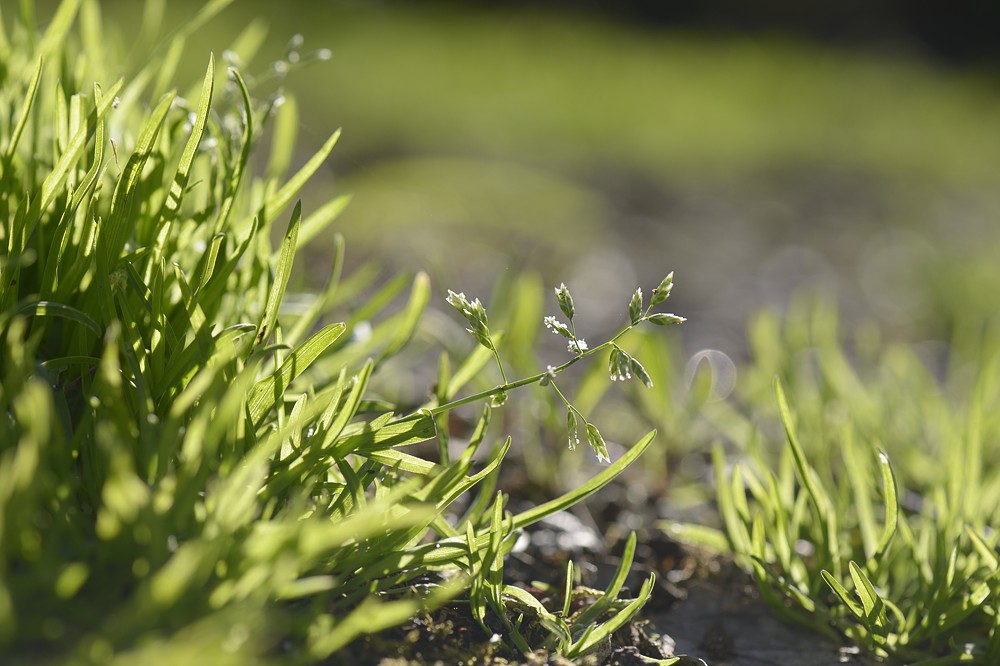


It is tiny so you have to look near your feet to see it. It is what you call an ordinary grass and it likes human presence where. It grows on sidewalks, between the pavement of a road, in forgotten corners of gardens and towns, around abandoned buildings, on walking paths. And also elsewhere.


The flowering stalks come out of a bunch of disorderly green leaves; those are slightly folded lengthwise.


Here, early in the morning, the flowers begin to open.


The small spikelets covered in dewdrops when opening, look more like a work of abstract art than like an inflorescence. The glumes, the small scarious scales that protect the spikelets are pink in this plant, bur often the plant is completely green, flowers included. Rhe stamens begin to get out, after a few hours they will release pollen in the wind.


March 21, 2017

Green Hellebore


The color of the Green hellebore (Helleborus viridis) justifies its name, it is really of an intense dark, green, green and you can see it when other plants do not yet show many green sprouts.


It makes big clumps on the forest floor at the end of winter.


Even the flowers are green, little bells hanging between big compound palmate leaves.


When wide open, you can see about twenty stamens and in their centre some pistils a bit longer.


Green Hellebore, here beside a fallen Hornbeam tree, looks very much like the other hellebore that grows in Dordogne, Stinking Hellebore, with paler flowers and a really bad smell. Green Hellebore is not as common as this species, you'll find it only in the deepest parts of valleys, under trees, and mostly not far from water.


March 11, 2017

Lawn Daisy


Everywhere on lawns and also elsewhere, Lawn Daisy (Bellis perennis).


Little radiant suns, a circle of pink-tipped ligulate flowers around a golden heart of tubular flowers.


A stem with a single flowerhead with typical hairs on the bracts.


And this stem comes out of a small basal cluster of leaves flat on the soil. Hoarfrost? No problem at all!


A bit of cold does not matter. The flower simply closes.


Here the flower in the rays of an end of the afternoon sun, beginning to close for the night.


February 18, 2017

Common Groundsel


We are only half way February and some plants already made seeds.


This small Common Groundsel (Senecio vulgaris) shows flower heads and buds but also already silvery fluff on ripe seeds. It is a very common plant and it flowers all year round. You can find it in vegetable gardens, ruderalised spots, in town, in agricultural fields, in fact nearly everywhere where the soil is fertile and there is not too much competition from other plants. Here, it choose to grow on top of an old wall covered in earth. The other spring flowers that grow here just start flowering; there are some blue spots of Birdeye Speedwell (Veronica persica) flowers still closed.


In every flower head there are quite a number of tubular flowers just sticking out from the tube formed by bracts with each a black point. The lobed leaves are curled at the rims and carry often hairs like spider webs.


Common Groundsel is a Ragwort, and it is poisonous for cattle but less poisonous than some other Ragwort species. Maybe because youdo not find it often in hay, and because grazing animals avoid eating it. Apparently it tastes bad.

January 29, 2017

Greater Burdock


Here we are in a plantation of young poplars not far from the Dordogne river.
In the background some coloured spots can be seen, it is blue plastic the owner wrapped around his young tree trunks to protect them against hungry roe deer. You can consider poplar plantations as a kind of nuisance because they destroy wetlands where otherwise many interesting wild plants would grow, that are now replaced by common ruderal plants. Like Burdocks. Here is a Greater Burdock (Arctium lappa) in winter attire. Well, you can't say it is uninteresting.


It is a majestic growth, because of its size of more than a metre high and its elegantly curved bows of dried flower heads.


The dried flower heads carry little hooks, and they are really appropriate to annoy your other children by putting them intheir hair. Nearly every child knows...


January 7, 2017

Montpellier Maple


In this deciduous forest in a winter fog all trees have lost their leaves, a small Oak excepted. At its right two slender tree trunks touch. Those are Montpellier Maples (Acer monspessulanum). A species that grows on some calcareous hillsides bur not everywhere.


No way to be mistaken, there are not that many trees that make so many small branches. They are mostly opposed and in other seasons carry small trilobed leaves.


In April Montpellier Maple makes small bundles of hanging flowers, and at the same time new leaves open.


No pollen-gatherer can be seen in this picture, but normally they are there, the flowers are very attractive for them.


Later on the flowers develop into winged fruits, called samaras. Here they are, in an autumn rain.


January 3, 2017

Hoarfrost


Nothing really special, this meadow with a bit of ruderalisation here and there. But some fog and hoarfrost changes everything.

Tor Grass (Brachypodium rupestre) takes the place of other grasses where the soil becomes a bit richer in nutrients.


Last summer's dead stems and leaves show a lot of colour compared to other grasses, and now a tiny white border of hoarfrost adds a little extra.


Bull Thistle (Cirsium vulgare) can grow in any spot where a seeds falls into loose and fertile soil, also in this meadow where wild boar sometimes dig the soil.


Withered flower heads and leaves are still beautiful, even when they are not anymore alive.


The fog lifts and sunshine comes through.


Wild Parsnip (Pastinaca sativa) is not a delicate plant, but you can say today it shows some refinement.


This bramble, a common Blackberry (Rubus fruticosus), shows its fiery colours against the light. This will not be for long, if the cold and frosty nights go on it will take a more subdued colour.