The flora of Périgord in South-West France is abundant and diverse. In this blog you can find, in pictures, brief encounters with several hundreds of wild flowers and plants as they grow here in French Perigord. Following the seasons other species are added. An index of scientific and English names you find below on the right.
Corine Oosterlee is a botanist and photographer and she offers guided Botanical Walks and other activities around plants and vegetation in nature in Perigord. Do you want to know more? On www.baladebotanique.fr you can find more information. For Corine's photography see www.corineoosterlee.com. Both websites also in English.
Enjoy!
July 19, 2017
Square-stalked Saint-John's-wort
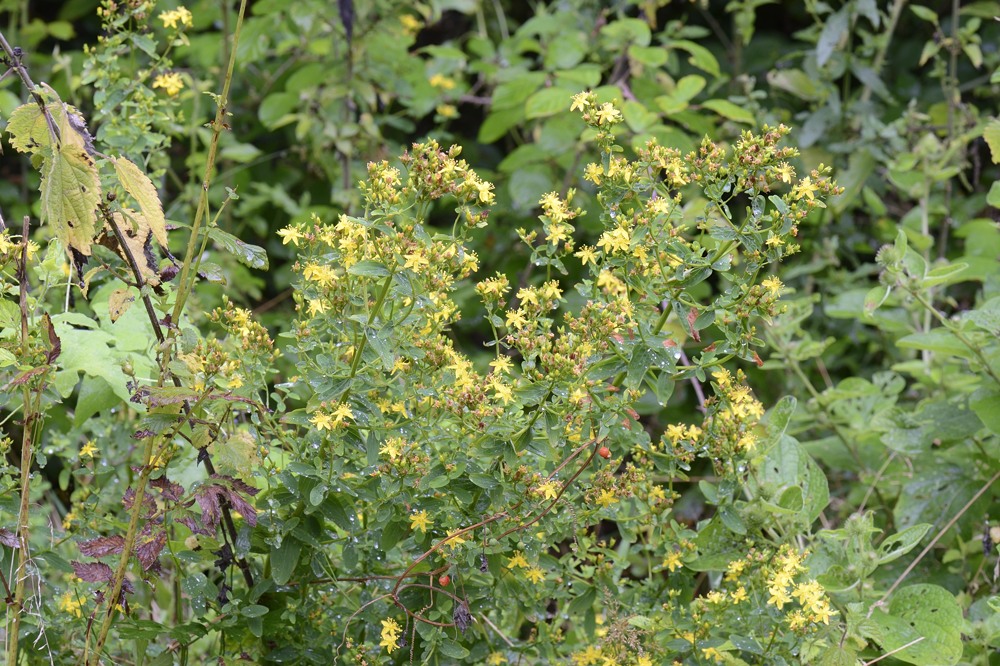
Square-stalked Saint-John's-wort (Hypericum tetrapterum) is prolific this summer, it has lots of flowers. It can grow nearly a meter high and it grows in marshy or swampy, or at least wettish, areas.
It has quadrangular stalks with distinct ridges. The leaves grow in opposite pairs and they are sessile. From most pairs of leaves emerge flowers.
In the leaves you can see tiny transparant points and sometimes also some small black points. They are just visible to the naked eye, a magnifying glass can be of help. The little black points are glands, and they are typical for hypericums. Square-stalked Saint-John's-wort does not have many of them compared to other species of this family.
The flowers are somewhat untidy little stars, five yellow petals and a bunch of stamens that go in all directions.
July 18, 2017
Lesser Scullcap
Not far from a the road that runs along a wet and slightly peaty area grows Lesser Scullcap (Scutellaria minor). It needs water and acidic soil to flourish and here, it finds both. In Perigord this kind of habitat is not very common, but in the open spaces of the Bessède forest you can find it. Flora here is very rich, and different from the plants you can find on dry Jurassic or Maestrichtian limestone soils that are more common in Perigord.
On the calyxes of the flowers of Lesser Scullcap grows, strangely enough, a kind of bump, whence its name. The little pink flowers are spotted with purple honey guides.
July 7, 2017
Perennial Pea
In the early morning there are still some dewdrops on the pink flowers of Perennial Pea (Lathyrus latifolius). They will disappear quickly when it gets hot.
It goes on and on flowering, even in the hot summer weather. Perennial Pea is the largest wild Pea you can find here. It can grow two meters long and, yes, it is a perennial plant. It does not look that big: It could use its tendrils to climb surrounding plants but often it stays near ground level.
Normally with Peas each leaf consists of a pair of folioles with a tendril in between (but of course there are exceptions). Often the stems are winged, this means they have two flattened strips on each side.
Perennial Pea likes borders, of fielsd, roads and woods. Here below it grows between the ferns at the edge of a chestnut wood. You can see the long pods already developing.
Perennial Pea is a near relative of the cultivated Sweet Pea, but in cotrast to this one, the wild plant does not have a particular smell.
July 2, 2017
Common Chicory
The Big Prize for the bluest flower will probably be given to Common Chicory (Cichorium intybus).
Below, this colour contrasts beautifully against the cereals ready for harvest that surround it. It can be found in cultivated fields, but also in gardens, on roadsides, or in wastelands.
The stalks zigzag everywhere. No leaves are visible any more, they have fallen off when flowering started.
Common Chicory is a sister of garden chicories and endives and, in fact, its leaves are edible, but very bitter, so you are not tempted to add them to a salad.
To see the flowers you should not wait until the end of the day.
You will not see anything but green stalks, the flowers open only in the morning and early afternoon.
June 18, 2017
Slender Bedstraw
Slender Bedstraw (Galium pumilum) is not a big plant. Its thin stalks go in all directions and blend in with surrounding vegetation. But its little cross-shaped flowers are a luminescent white, so luminescent that you have to look at it.
It likes dry limestone soils and sunny places. In a rich meadow with high, luxuriant vegetation you will not find it.
It is a typical bedstraw and shows the typical features of the Rubiaceae family it belongs to. A crown of long pointed leaves at everynode, small flowers like four-pointed stars in loose panicles, supple stalks.
It starts flowering in May and we can enjoy it for still a while, it goes on until the droughts of summer really set in.
June 17, 2017
Cutleaf Selfheal
At this moment the little Cutleaf Selfheal (Prunella laciniata) is in full bloom in limestone meadows. It loves the sun, so it is very happy those days!
It is a Lamiaceae, with a square stalk and opposite leaves, in fact the whole plant has something square and symmetric. There are other selfheals, but those mostly have blue flowers (like as an exemple 'Truncate Selfheal').
In the pictures it is surrounded by other flowers of this habitat. Above by Slender Bedstraw (Galium pumilum), and below by Horseshoe Clover (Hippocrepis comosa).
May 21, 2017
Knotted Crane's Bill
Early this spring those leaves appeared in a wooded valley, under the trees near a small stream. Beautiful leaves, a bit shiny, on reddish creeping stems hidden under fallen leaves.
What plant is this? Difficult to say, especially when you see no flower. The leaves look a bit like those of Boston Ivy, but not exactly. Also Crane's Bill species can have this kind of leaves, only the plant does not look at all like other Crane's Bills known in Dordogne.
Some week laters, flower buds appeared.
And those really look like Crane's Bill buttons. But which one? Not that easy when there are no fruits and flowers that can help with identification. Some searches in floras and on the web result in Knotted Crane's Bill (Geranium nodosum) as a diagnosis; the plant has all caracteristics and also some particularities of this species.
Wait and see. There will be flowers.
They are a pale lavender-pink, with some purple stripes. Now there is less doubt, it really seems to be Knotted Crane's Bill.
Knotted Crane's Bill is a plant frow lower mountainous regions, and it has not been seen in Dordogne recently. It is sometimes found in the neighbouring Lot department, but it grows mostly in the lower reaches of Alps and Pyrenees. Perigord is not that mountainous. But the spot here, a shadowy not too dry valley on calcareous soil could match. Another possibility could be this is not a really wild plant but one escaped from a garden.
From where comes this plant? Does it grow here since a long time?
Is it possible it is a really wild plant, but that nobody has found it until now? Yes, it is an isolated spot and this is not exactly the kind of plant that jumps to the eye; the flowers are not that noticeable. No one ever comes here, except maybe hunters in winter.
Other rare plants thrive in this little valley, a sure sign you can find here a combination of environmental factors that is or has become rare. Like soil caracteristics, vegetation, (micro)climat), undisturbed-ness. It is possible this place has not been touched by developments (often under human influence) that changed habitats elsewhere, like plantations, changes in water quality, clearing, and that species could survive here.
Knotted Crane's Bill is cultivated as an ornamental plant since long, and Perigord has known a more dense population as today. This plant could have arrived with garden detritus, or grown from seeds from a garden plant, or even be planted long ago. Nearby there are ruins of an old water mill, and the stream has been managed in former centuries. If it is cultivated, you would expect other signs of human occupation, other cultivated plants. But here are none, so it is all speculation.
Whatever, Knotted Crane's Bill is here, and it is flourishing.
Subscribe to:
Posts (Atom)