The flora of Périgord in South-West France is abundant and diverse. In this blog you can find, in pictures, brief encounters with several hundreds of wild flowers and plants as they grow here in French Perigord. Following the seasons other species are added. An index of scientific and English names you find below on the right.

Corine Oosterlee is a botanist and photographer and she offers guided Botanical Walks and other activities around plants and vegetation in nature in Perigord. Do you want to know more? On www.baladebotanique.fr you can find more information. For Corine's photography see www.corineoosterlee.com. Both websites also in English.

Enjoy!


March 27, 2018

Ivy-leaved Speedwell


This Speedwel is one of the first to flower and it is really tiny. It is easy to find on old stone walls, in gardens and on the sides of a walking path. Its leaves look a little bit like those of Ivy, hence its name, Ivy-leaved Speedwell (Veronica hederifolia).


Only when the sun shines the blue flowers open and show their white inside, they are not bigger than half a centimeter.


Like in other Speedwells, the crown has four lobes.


It is end of March and already fruits develop.


March 25, 2018

Hairy Violet


Normally Hairy Violets (Viola hirta) do not grow in wet places, but here it grows near a stream amongst yellow Lesser Celandines (Ficaria verna).


Small spring violets are much alike. The difference between species is in the details.


The Hairy violet has rounded sepals...


... and, as its name says, hairs. You can find them on the new leaves, but they are very short and nearly invisible if you don't use a magnifying glass.


Here are some plants growing amidst dead ferns at a wood edge, the usual habitat for this species.


March 15, 2018

Fritillary


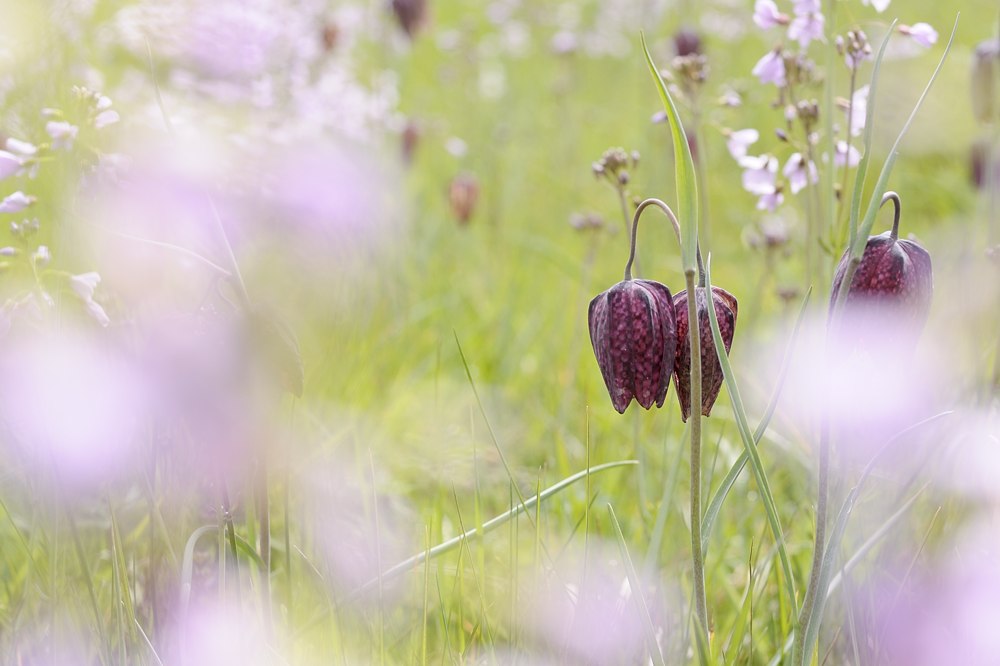
The Fritillaries (Fritillaria meleagris) are in flower!


Every year in March they are having a party.

In wet valleys you can find the purple bells, in a sunny meadow or near the stream under the trees.


Normally they are surrounded by other spring flowers, here with contrasting yellow Lesser Celandines.


Or, to stay with pink and purple, wuth Cuckoo flowers.

Enjoy!


March 13, 2018

Plymouth Thistle


In the center of a very small road all kinds of plants grow, the tarmac is nearly invisible. Thorny rosettes came out last autumn, normally they should give stems with flowers this year.


In this place it is not very probable that big thistles will develop. Just beside the road there is another rosette. Here circumstances are better for the development of the Plymouth Thistle (Carduus pycnocephalus).


The leaves are a bit soft and hairy at the underside. The points that carry spines are white.

Plymouth Thistle is a rather spindly plant. It flowers end of May and June with many small flower heads.


Maybe its colour is a bit more pink than other thistles. The stalks are covered in fine hairs and  spines that give it a silvery sheen. The leaves are no longer soft, and really thorny.


Under the flowers the stalk has no thorns but only short, silky hairs.


Plymouth Thistle is very rare in Dordogne, but maybe its presence is underestimated, it is not a very conspicuous plant. It grows in cultures and ruderalized corners. Originally a plant from the Mediterranean it has been introduced in America and Australia where it is now considered as a pest difficult to eradicate. But here you are glad when you meet it!


February 28, 2018

Dandelion


In well-protected spot the first dandelions (Taraxacum sp.) show their yellow faces.


A ray of sunshine makes it happen, even if it is cold.


Here they brighten up an old open-air washing place.

Dandelions are not specuies like other plants. It is difficult to decide of which species the genus Taraxacum is made. Often Dandelions reproduce in an agamosperm way, this means that new plants grow from seeds that come from unfertilized oocytes, so they are clones from a mother plant. It can be that a whole population is descended from a single plant, so it is rather an asexual line than a species. If we considered every line as a species, there would be hundreds or even thousands of dandelion species. Another complication: some plants show sexual reproduction and it is possible to find hybrids next to lines.

For practical reasons, lines that resemble each other are grouped into sections.


Big chance the flowers in this picture are Taraxacum fasciatum, a line that is part of the  Ruderalia, the most common section in Dordogne.


Blow!


If you look from nearby, you see the spiny tops of the seeds. Their colour varies with line/species.

February 13, 2018

Stinging Nettle


Stinging Nettles (Urtica dioica) are robust plants. They went on growing all winter notwithstanding rain, snow and frost and now they look a bit crumpled, but no more than that.


The Stinging Nettle likes nitrogen, so you can find him in many places where humans altered the soil and also in places where there is a natural supply of this stuff. Wastelands, vacant plots, abandoned compost and manure, gardens, riversides...


They sting but nevertheless they are beautiful with this frosty edge.


Stinging Nettles are dioecious, that means that male and female flowers do not grow on the same plant. Here is one with female flowers already in fruit. Seeds can rest for a very long time in the soil and await the right moment to germinate, which helps to explain the resilience of Stinging Nettles.


A butterfly, The Small Tortoiseshell (Aglais urticae), deposits its eggs on them. Many small caterpillars feed on leaves and flowers.


Who is looking? Maybe he looks menacing but he is a strict vegetarian...

February 10, 2018

Rosettes


After a rather warm month of January, rosettes of wild orchids develop well. Roots or tubercules of Orchids from here hibernate in the soil. Many species show their first leaves long before the flowering stalks appear, at the end of winter. Often many kleaves have already disappeared when the plant flowers.


Under an oak tree on the roadside this rosette is really on show. It is rather big and belongs to a Fly Orchid (Orchis insectifera), an orchid that is not rare at all on limestone soil in Perigord.


In May, when it flowers, it is more difficult to find a Fly Orchid amidst other green plants,  its little black flowers are not that conspicuous. And yes, in fact they look really like a fly, antennae and wings included.


In this limestone meadow many orchids flower later in the year. Here the rosettes from the two species that are very abundant here. From the three rosettes with greyish and roundish leaves will grow the flower stalks of the Western Spider Orchid (Ophrys occidentalis). The rosette with long, curved green leaves is a Green-winged Orchid that begins to flower two weeks later.


The Western Spider Orchidis about ten to twenty centimeters high. This one just begins flowering and it is still very small.


A budding Green-winged Orchid.