The flora of Périgord in South-West France is abundant and diverse. In this blog you can find, in pictures, brief encounters with several hundreds of wild flowers and plants as they grow here in French Perigord. Following the seasons other species are added. An index of scientific and English names you find below on the right.

Corine Oosterlee is a botanist and photographer and she offers guided Botanical Walks and other activities around plants and vegetation in nature in Perigord. Do you want to know more? On www.baladebotanique.fr you can find more information. For Corine's photography see www.corineoosterlee.com. Both websites also in English.

Enjoy!


April 28, 2018

Common Dog Violet


The blue Violets that flower in April are very much alike. See here the Common Dog Violet (Viola riviniana).


It look rather rectangular. It has to be admitted, violets do show a temperament.


This one grows in woods on neutre or slightly acidic soils in little rather loose bunches. If there is a leaf rosette of a kind, it is not at ground level but halfway up a stalk.


Common Dog Violet has a big white spur and pointed sepals...


... and a striped lower lip.


Here it grows between leaves of a Sweet Chestnut that, like the Violet, does not like calcareous soils.


April 18, 2018

Burnt Orchid


At sunset in a meadow. Those flower heads look like they got a dark red sunburn, but it is just the colour of the new flower buds. The lower flowers of Burnt Orchid (Neotinea ustulata) open up first, the dark red buds on top of the stalk remain closed much longer. The plant looks a bit damaged, a rabbit has eaten part of the leaves and flowers.


A few days later early in the morning. Nearly all flowers are open now.


This orchid is about 10-20 cm high and is rather common in limestone meadows.


While flowering the plants get longer and longer. Here, on a rainy May day, the first fruits appear.


Every plant is different (as in many orchid species) Nearly always there are one or more red spots on the lower lip, and a dark red upper petal.


The Japanese flag, or a face, or... ?


April 8, 2018

Greater Stitchwort


To begin with there were only those long leaves that look so much like grass blades, each with its own dewdrop.


But that was a month ago. Now the Greater Stitchwort (Stellaria holostea) is flowering.


It is never alone, when there is one flower it is accompanied by a hundred others. This perennial plant lives in groups, it embellishes roadsides and edges of woods or grasslands with large amounts of white flowers.


Everyone of the five petals is deeply divided and has two lobes, there are ten yellow stamina and three pistils, and in every flower it is exactly the same. Who says that flowers can't count?


Transparancy and soft focus... for the time being, in a few weeks the flowering is over and Greater Stitchwort is making fruits, and then it disappears until next year.


March 27, 2018

Ivy-leaved Speedwell


This Speedwel is one of the first to flower and it is really tiny. It is easy to find on old stone walls, in gardens and on the sides of a walking path. Its leaves look a little bit like those of Ivy, hence its name, Ivy-leaved Speedwell (Veronica hederifolia).


Only when the sun shines the blue flowers open and show their white inside, they are not bigger than half a centimeter.


Like in other Speedwells, the crown has four lobes.


It is end of March and already fruits develop.


March 25, 2018

Hairy Violet


Normally Hairy Violets (Viola hirta) do not grow in wet places, but here it grows near a stream amongst yellow Lesser Celandines (Ficaria verna).


Small spring violets are much alike. The difference between species is in the details.


The Hairy violet has rounded sepals...


... and, as its name says, hairs. You can find them on the new leaves, but they are very short and nearly invisible if you don't use a magnifying glass.


Here are some plants growing amidst dead ferns at a wood edge, the usual habitat for this species.


March 15, 2018

Fritillary


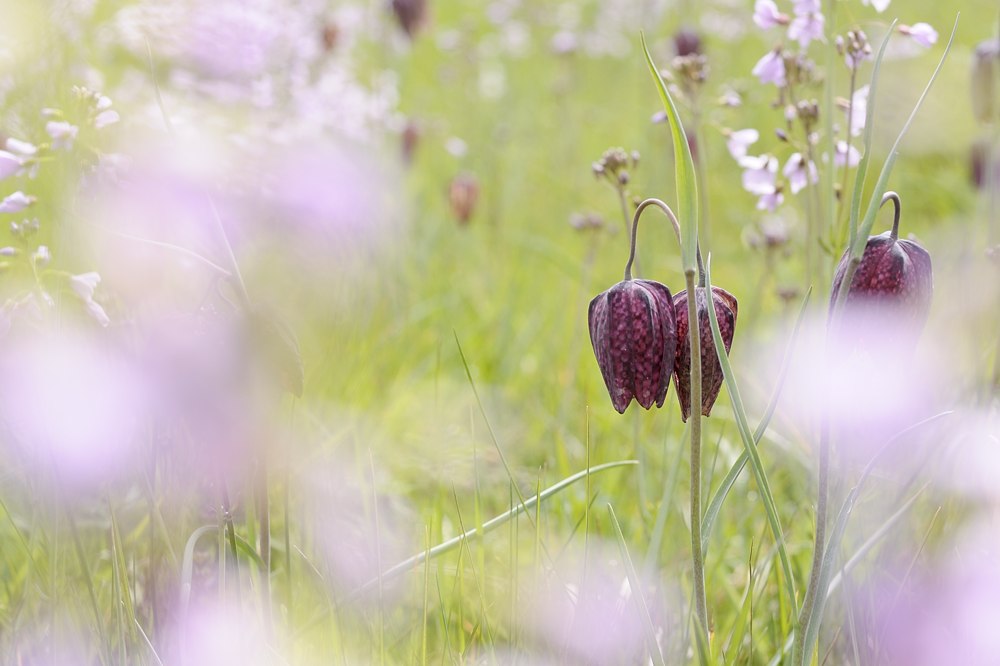
The Fritillaries (Fritillaria meleagris) are in flower!


Every year in March they are having a party.

In wet valleys you can find the purple bells, in a sunny meadow or near the stream under the trees.


Normally they are surrounded by other spring flowers, here with contrasting yellow Lesser Celandines.


Or, to stay with pink and purple, wuth Cuckoo flowers.

Enjoy!


March 13, 2018

Plymouth Thistle


In the center of a very small road all kinds of plants grow, the tarmac is nearly invisible. Thorny rosettes came out last autumn, normally they should give stems with flowers this year.


In this place it is not very probable that big thistles will develop. Just beside the road there is another rosette. Here circumstances are better for the development of the Plymouth Thistle (Carduus pycnocephalus).


The leaves are a bit soft and hairy at the underside. The points that carry spines are white.

Plymouth Thistle is a rather spindly plant. It flowers end of May and June with many small flower heads.


Maybe its colour is a bit more pink than other thistles. The stalks are covered in fine hairs and  spines that give it a silvery sheen. The leaves are no longer soft, and really thorny.


Under the flowers the stalk has no thorns but only short, silky hairs.


Plymouth Thistle is very rare in Dordogne, but maybe its presence is underestimated, it is not a very conspicuous plant. It grows in cultures and ruderalized corners. Originally a plant from the Mediterranean it has been introduced in America and Australia where it is now considered as a pest difficult to eradicate. But here you are glad when you meet it!