The flora of Périgord in South-West France is abundant and diverse. In this blog you can find, in pictures, brief encounters with several hundreds of wild flowers and plants as they grow here in French Perigord. Following the seasons other species are added. An index of scientific and English names you find below on the right.

Corine Oosterlee is a botanist and photographer and she offers guided Botanical Walks and other activities around plants and vegetation in nature in Perigord. Do you want to know more? On www.baladebotanique.fr you can find more information. For Corine's photography see www.corineoosterlee.com. Both websites also in English.

Enjoy!


February 28, 2019

Narrow-leaved Lungwort


Leaves of Narrow-leaved Lungwort (Pulmonaria longifolia) can be found nearly all year round. Look for them in woods, along a path, especially under Chestnuts or other trees that grow on acidic soil. The leaves are spotted, white on green, and with some ( a lot of!) phantasy you could say to look like the inside of a lung. Whence its name. By analogy, according to some, the plant could be used in medecine against lung diseases. Well, let us leave aside beliefs...


At this moment they make little leaf rosettes in which the flower buds are already visible. As with many spotted plants, every individual has its own pattern of spots, form, size and intensity specific for it. There are no twoi plants that look alike.
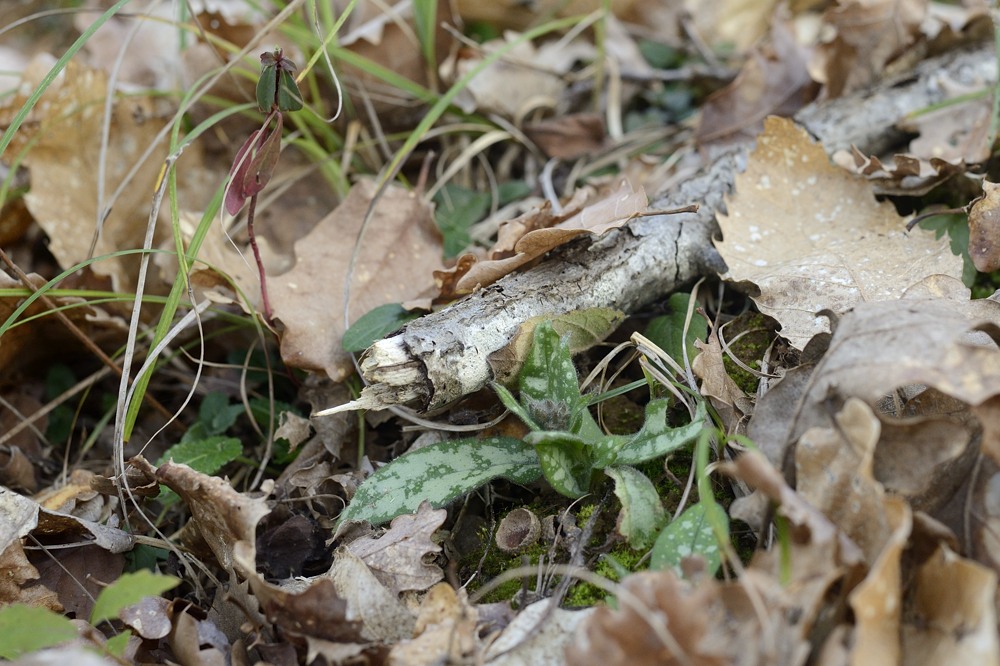


The plant her below still has a leaf from last year. In summer, Narrow-leaved Lungwort makes far bigger leaves, until 50 cm long. The old leaves disappear in winter. Except the one here, it seems.


Now, end of February, the first flowers are already open. And what flowers!


Nothing out of normal, this is a plant that flowers early, at the end of winter. The exceptionally warm and sunny weather of last weeks did not have that much effect on the flowering; the cold nights really slowed down growth.


February 11, 2019

Hornbeam


The Hornbeam (Carpinus betulus) is a very common tree in Perigord. It grows mostly on northern slopes and in deep valleys, where it can develop into large shadowy forests. It replaced beeches that have nearly disappeared from Dordogne. Same kind of tree, nearly the same kind of habitat. Normally, Hornbeams do not grow old. It is not every day you meet an old Hornbeam like this one. This Methusalem is rather high than broad and its trunk has thick irregular ridges, as if it consisted of many interwoven thin trees.


It is normal for a Hornbeam to have a ribbed trunk, as you can see here below. On younger trees it is sometimes difficult to see, but if you pass your hand over the bark you feel the twists in the wood under it.


Nearly invisible in the picture: the buds begin to grow in this still wintry copse. Hornbeams develop their leaves a bit earlier than Oaks and Chestnuts. Wait some weeks, and the new leaves will come out.


End of March, here are the leaves!


They look much like Beech leaves, but they are not as shiny and of a lighter green, and there are no hairs on the leaf edges.

The catkins - here below the male ones - develop at the same time as the leaves.


They move with the wind that takes the pollen wherever it wants.


January 30, 2019

Fly Honeysuckle


This Honeysuckle is not a creeper or climber.


In winter the Fly Honeysuckle (Lonicera xylosteum) seems a rather unimpressive bush. Rather small, with grey opposite branches. There are still some oval leaves left, also opposite. They are yellowish and dirty after a long season of photosynthesis.


It is quite common in our woodlands, not only at the edges but also in deep shade under the trees, with a slight preference for limestone soils. Here you see it in the midst of summer, you don't think immediately it is a Honeysuckle.

In spring, when it flowers it really looks like a Honeysuckle.


The shape of its leaves, the colour of the young branches, and especially the perfumed flowers: yes, a Honeysuckle. Because the flowers have no long tube, they are accessible to many insects, not only butterflies. Maybe that's why it is called Fly Honeysuckle.

What a joy to find it!


December 20, 2018

Maidenhair Spleenwort


In a wood on a steep Northern slope grow Oaks and Beeches that nearly never see the sun. Hidden between the trees, high above the river Dordogne there are some limestone cliffs. Here grows this little fern.


It is a Maidenhair Spleenwort (Asplenium trichomanes), but which one? In Dordogne there are three subspecies known, and this one is rather atypical.

Generally, Maidenhair Spleenworts grow on stone walls or vertical rocks, like here. They all have fronds with a dark brown  central stem, the rachis, that is pinnate compound, with on both sides small simple green leaves.


Here a Common Maidenhair Spleenwort as can be found in many places: Asplenium trichomanes subsp. quadrivalens. It has rather long fronds tapering towards the end, with symmetrical pinnate leaves that are finely dented.

The subspecies here below grows mainly on vertical limestone rocks, like cliffs or cave entrances.


This Maidenhair Spleenwort  (Asplenium trichomanes subsp. pachyrachis) is much less common, already because the right kind of vertical limestone rock is not everywhere, not even in Perigord. It is tiny and its fronds follow the rock surface as if they are glued to it. The pinnate leaves cover each other like roof tiles.


But this fern? It looks a bit like the subspecies above, but...


It has rather long pinnate leaves lobed like little hands that do not cover each other like roof tiles. And the end leaf is at least twice as big as the others. The fronds are free from the rock, not glued to it, and they heve everywhere the same width instead of tapering. It does not look like a Perigordian subspecies, it looks more like a subspecies that grows exclusively in the Alps. Quite improbable to find that one here...

Moreover, when you look at the underside of a fertile frond as in the centre of the image here below, you see is has not many sores. The sores are the whitish small structures wherein sporangia (here tiny black points) develop. Are there fertile spores in those sporangia? Now way to know without a microscope.


Hybrid plants are sometimes less fertile than pure species. Is it possible this plant is a hybrid, and in case of yes, between which species or subspecies?
Maybe yes. We do not know yet very well the Spleenworts and their subdivisions and how species and subspecies can be distinguished and how they differ. They are tiny plants, often rather inconspicuous and growing in places difficult to get to. Not easy for botanists.


December 5, 2018

'Holy Hawksbeard'


In this graveyard there are not only the faded chrysanthemums of last month. Near a tomb slmall yellow flowers are opening themselves to the December sun.


This Hawksbeard has no official English name, so let us call it 'Holy Hawksbeard'(Crepis sancta subsp. nemausensis). It is a little Asteraceae that normally flowers in Mediterranean regions at the end of winter or the beginning of spring. The last years it is seen more and more North of its area, and now it is common in Dordogne. But to see it in flower in December is really exceptional.

It does not grow only in cemeteries, also in vineyards, gardens, and trodden places in towns.


Its little rosettes are visible a long time before the flowers appear. Here they are surrounded by at least eight other plant species; the blue-green rosette is from a Prickly Sow-Thistle (Sonchus asper).


To open up the flowers need sunshine.

December 4, 2018

Sweet Chestnut (2)


The Sweet Chestnut (Castanea sativa) has beautiful leaves, long and regular and very green.


In October they fall, a bit before the leaves of most Oaks. At least in a normal year, this year there will be leaves on the trees around christmas!


Sweet Chestnut leaves are dented, and every dent has a fine point. Decomposition by fungi and bacteria creates little black spots on the leaves.

Many Sweet Chestnut trees end their lives when they are still rather young. To make fence posts you don't need a big diameter. Chestnut wood is nearly imputrescent and is for this reason long lasting. In former times it was used also for stakes in vineyard and to make hoops for barrels.


Many Sweet Chestnut woods in Dordogne were coppiced. Regrowth after felling gives after ten or fifteen years bunches of not too big trunks.


You can see the trees are not in very good health, Sweet Chestive are sensitive to all kinds of diseases, bleeding cancer and others.


This tree is old, planted maybe eighty or sixry years ago. It is surrounded by its progeniture.


December 3, 2018

Sweet Chestnut (1)


Sweet Chestnut (Castanea sativa) is a typical Perigordin tree. It grows everywhere where the soil is not limestone. Today's Chestnut woods are the descendants of former Sweet Chestnut forests planted for their fruits and wood. People, especially the poor, harvested chestnuts for flour. This very big trunk here below is what is left from a tree planted long ago, it is dying from old age now.


Don't worry, new trees begin to grow at the feet of this Methusalem.

Here, in June, a Sweet Chestnut wood in flower. Fluffy bunches of male catkins give the trees a festive look.


The male flowers in long catkins produce masses of pollen which the wind brings everywhere. There is a dusty smell in the air. The female flowers are very tiny and you don't notice them when you don't look from nearby.


Chestnut season is October. The burrs, with their nasty spikes that protect them against hungry intruders, open up when the fruits inside are ripe.


And now the feast can begin. Wild boar, badgers, mice, jays and other animals adore chestnuts and now they eat and eat and eat until they just can't anymore. They cannot eat everything, the tree has let loose all its fruits at once en there is too much food. So the tree can be sure at last some chestnuts remain un-eaten and can germinate.


Here, a mouse had its dinner, and a little slug takes care of the leftovers.