The flora of Périgord in South-West France is abundant and diverse. In this blog you can find, in pictures, brief encounters with several hundreds of wild flowers and plants as they grow here in French Perigord. Following the seasons other species are added. An index of scientific and English names you find below on the right.

Corine Oosterlee is a botanist and photographer and she offers guided Botanical Walks and other activities around plants and vegetation in nature in Perigord. Do you want to know more? On www.baladebotanique.fr you can find more information. For Corine's photography see www.corineoosterlee.com. Both websites also in English.

Enjoy!


March 14, 2019

Hornbeam flowers


Hornbeams (Carpinus betulus) are in flower now!


Here a twig with some male catkins, and, in the center of the image, a smaller female one.


A female catkin with some flowers, only the red pistils and some green scales are visible.

March 10, 2019

Cherry Plum


March shower.


Cherry Plum (Prunus cerasifera) petals are falling.


March 9, 2019

Field Elm


Hurry if you want to see the Field Elm (Ulmus minor) in bloom, it will be over quickly!

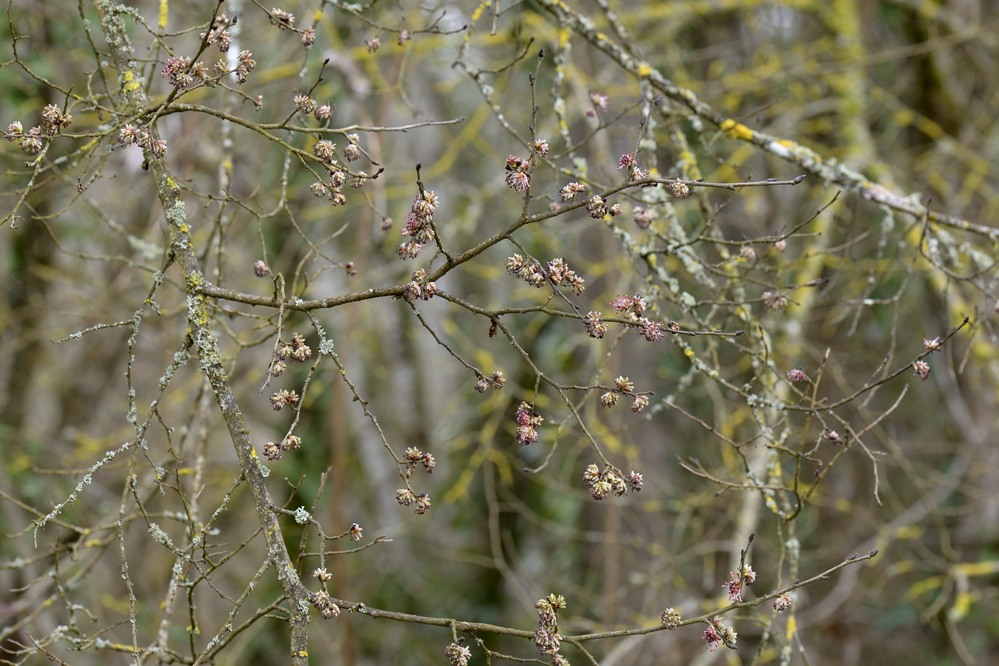
To begin with, you have to find a Field Elm. That should not be difficult, it is a common tree. Probably you will find one on the banks of the Dordogne or another river. At this moment you can recognize it by the little reddish or pale balls that cover its branches.


A rather unassuming flowering, but until now the avalanche of spring flowers is not yet there, so those little flowers stand out.


Every little ball has stamina and pistils and not much else. Maybe a scale that covered the bud before opening is still there. The buds that are going to give leaves are still very closed.


The ball at the left begins to come out, the stamina grow longer and some of them show already some pollen. Also the pistils, looking like little white feathers, get out. The flower head at the right is already at the end of flowering, only some dried-out stamina still cling to it and the white feathers of the female flowers are more abundant now. The fruits begin to develop, they are light green surrounded by rust-coloured membranous scales and crowned by a pistil.


The same thing again. To the left a flower head at the end of flowering, to the right one at its start. As in many anemophylic plants (plants that need wind to dispers their pollen), the pistils develop after the stamina.

Maybe you don't think this stunning but...

March 6, 2019

Ash


Not far from a small stream with a row of Lombardy Poplars, at the edge of a field, grow some big trees with rounded treetops. Those rather majestic trees are Ashes (Fraxinus excelsior).


They grow nearly everywhere where there is enough moisture in the soil, not only as solitary trees but also as a part of deciduous forests and along rivers.


Those three Ashes are grown so high their treetops are hidden from view by lower vegetation; the leaves in the picture are those of trees and bushes that surround them.


On young trees the bark is smooth, when it grows older crevasses form, and the trunk begins to look like that of an Oak.


The leaves are pinnate and deep green. Here below you see those of a young tree from this year besides some Great Horsetails.


And now, in March, the flower buds of Ashes come out. Buds of flowers and leaves are black.


This tree here only has male flowers. There are no petals or sepals, the stamina, some of them already open, are bare.


February 28, 2019

Narrow-leaved Lungwort


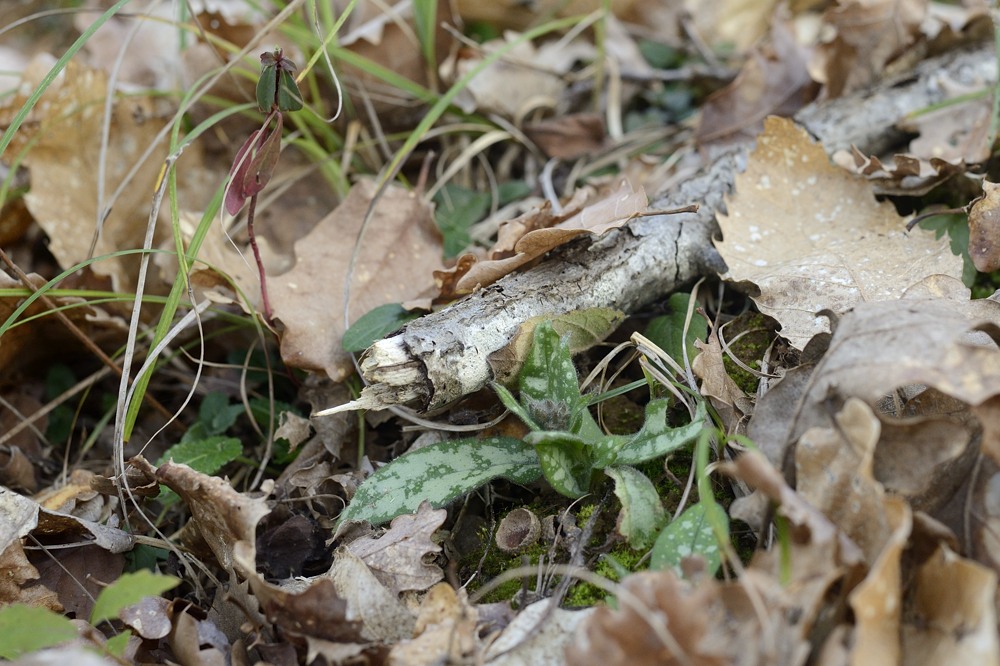
Leaves of Narrow-leaved Lungwort (Pulmonaria longifolia) can be found nearly all year round. Look for them in woods, along a path, especially under Chestnuts or other trees that grow on acidic soil. The leaves are spotted, white on green, and with some ( a lot of!) phantasy you could say to look like the inside of a lung. Whence its name. By analogy, according to some, the plant could be used in medecine against lung diseases. Well, let us leave aside beliefs...


At this moment they make little leaf rosettes in which the flower buds are already visible. As with many spotted plants, every individual has its own pattern of spots, form, size and intensity specific for it. There are no twoi plants that look alike.


The plant her below still has a leaf from last year. In summer, Narrow-leaved Lungwort makes far bigger leaves, until 50 cm long. The old leaves disappear in winter. Except the one here, it seems.


Now, end of February, the first flowers are already open. And what flowers!


Nothing out of normal, this is a plant that flowers early, at the end of winter. The exceptionally warm and sunny weather of last weeks did not have that much effect on the flowering; the cold nights really slowed down growth.


February 11, 2019

Hornbeam


The Hornbeam (Carpinus betulus) is a very common tree in Perigord. It grows mostly on northern slopes and in deep valleys, where it can develop into large shadowy forests. It replaced beeches that have nearly disappeared from Dordogne. Same kind of tree, nearly the same kind of habitat. Normally, Hornbeams do not grow old. It is not every day you meet an old Hornbeam like this one. This Methusalem is rather high than broad and its trunk has thick irregular ridges, as if it consisted of many interwoven thin trees.


It is normal for a Hornbeam to have a ribbed trunk, as you can see here below. On younger trees it is sometimes difficult to see, but if you pass your hand over the bark you feel the twists in the wood under it.


Nearly invisible in the picture: the buds begin to grow in this still wintry copse. Hornbeams develop their leaves a bit earlier than Oaks and Chestnuts. Wait some weeks, and the new leaves will come out.


End of March, here are the leaves!


They look much like Beech leaves, but they are not as shiny and of a lighter green, and there are no hairs on the leaf edges.

The catkins - here below the male ones - develop at the same time as the leaves.


They move with the wind that takes the pollen wherever it wants.


January 30, 2019

Fly Honeysuckle


This Honeysuckle is not a creeper or climber.


In winter the Fly Honeysuckle (Lonicera xylosteum) seems a rather unimpressive bush. Rather small, with grey opposite branches. There are still some oval leaves left, also opposite. They are yellowish and dirty after a long season of photosynthesis.


It is quite common in our woodlands, not only at the edges but also in deep shade under the trees, with a slight preference for limestone soils. Here you see it in the midst of summer, you don't think immediately it is a Honeysuckle.

In spring, when it flowers it really looks like a Honeysuckle.


The shape of its leaves, the colour of the young branches, and especially the perfumed flowers: yes, a Honeysuckle. Because the flowers have no long tube, they are accessible to many insects, not only butterflies. Maybe that's why it is called Fly Honeysuckle.

What a joy to find it!