The flora of Périgord in South-West France is abundant and diverse. In this blog you can find, in pictures, brief encounters with several hundreds of wild flowers and plants as they grow here in French Perigord. Following the seasons other species are added. An index of scientific and English names you find below on the right.

Corine Oosterlee is a botanist and photographer and she offers guided Botanical Walks and other activities around plants and vegetation in nature in Perigord. Do you want to know more? On www.baladebotanique.fr you can find more information. For Corine's photography see www.corineoosterlee.com. Both websites also in English.

Enjoy!


April 20, 2019

Judas Tree


On the Perigordean 'causses', the limestone slopes and hilltops coverend with stunted Pubescent Oak trees,, you can see now flashes of fluorescent pink. The Judas Tree (Cercis siliquastrum) is a medeiterranean bush or small tree that seems to thrive here. It comes from gardens and it does very well in nature without becoming invasive.


It is a leguminose species that flowers abundantly with little butterfly-loke flowers that grow on older branches and the treetrunk.


The new sprouts only have leaves. But how pretty they are!


A solitary fluorescent pink bud on a thick branch looks like an extraterrestrian.


In summer, the Judas Trees makes luminous red pods.


And its autumn colours are not bad at all.

So, we can be happy it wants to live here.


April 9, 2019

Vernal Sedge


The first Sedge that flowers in spring is already nearly done. The stamina of Vernal Sedge (Carex halleriana) got rid of their pollen and they are nearly dried out by now; the stems that carried flowers now look like little brown clubs.


Vernal Sedge is a species from limestone soils and it likes dry and sunny spots.


It has two kinds of flowering stems. The larger ones have male flowers and sometimes some small ears with female flowers.


Below, more or less hidden between the leaves, are some female ears with white pistils on very thin stalks.


The dry grey leaves are from last year.


March 30, 2019

Thale Cress


Thale Cress (Arabidopsis thaliana) is a plant from the Brassicaceae family, cousin of cabbages and mustards. It is small and slender.


It looks like nothing much, little white flowers four petals each on a thin stalk. The fruits, siliquas, are long and narrow. The plant is nearly without leaves, the basal rosette has disappeared when flowering began. But Thale Cress knows how to make seeds, however.


See here the results in good circumstances, in a field sowed with grass seed that did not germinate as it should. Instead of grass, enormous amounts of Thale Cress have emerged.


Thousands of little plants tremble with the breeze. It is very well possible next year will be completely different, there will be grass and millions of Thale Cress seeds will wait for another year.


But for now everything goes very well for Thale Cress.


March 14, 2019

Hornbeam flowers


Hornbeams (Carpinus betulus) are in flower now!


Here a twig with some male catkins, and, in the center of the image, a smaller female one.


A female catkin with some flowers, only the red pistils and some green scales are visible.

March 10, 2019

Cherry Plum


March shower.


Cherry Plum (Prunus cerasifera) petals are falling.


March 9, 2019

Field Elm


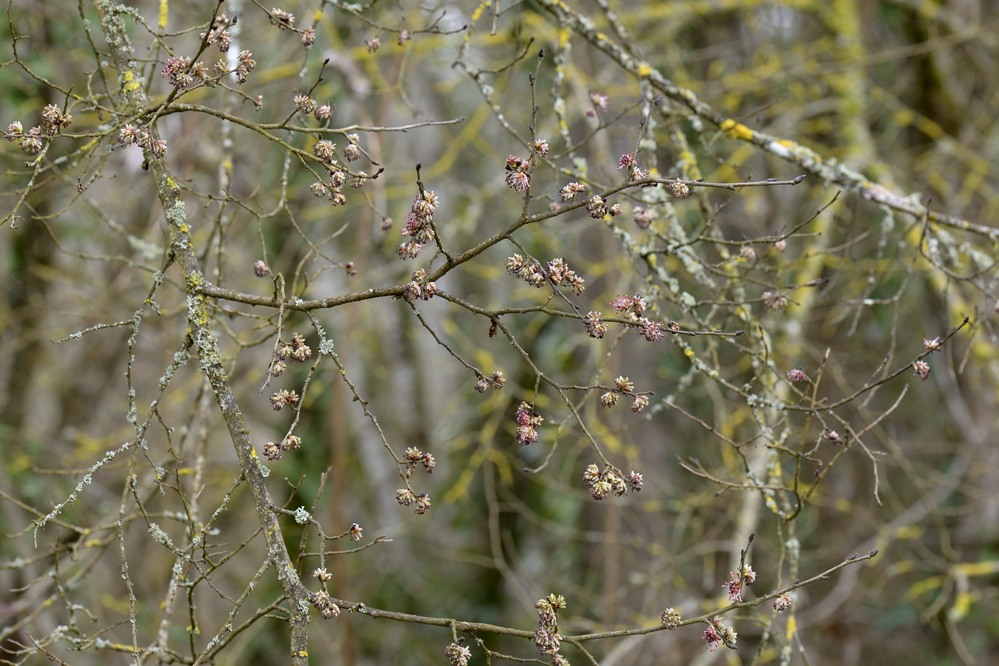
Hurry if you want to see the Field Elm (Ulmus minor) in bloom, it will be over quickly!

To begin with, you have to find a Field Elm. That should not be difficult, it is a common tree. Probably you will find one on the banks of the Dordogne or another river. At this moment you can recognize it by the little reddish or pale balls that cover its branches.


A rather unassuming flowering, but until now the avalanche of spring flowers is not yet there, so those little flowers stand out.


Every little ball has stamina and pistils and not much else. Maybe a scale that covered the bud before opening is still there. The buds that are going to give leaves are still very closed.


The ball at the left begins to come out, the stamina grow longer and some of them show already some pollen. Also the pistils, looking like little white feathers, get out. The flower head at the right is already at the end of flowering, only some dried-out stamina still cling to it and the white feathers of the female flowers are more abundant now. The fruits begin to develop, they are light green surrounded by rust-coloured membranous scales and crowned by a pistil.


The same thing again. To the left a flower head at the end of flowering, to the right one at its start. As in many anemophylic plants (plants that need wind to dispers their pollen), the pistils develop after the stamina.

Maybe you don't think this stunning but...

March 6, 2019

Ash


Not far from a small stream with a row of Lombardy Poplars, at the edge of a field, grow some big trees with rounded treetops. Those rather majestic trees are Ashes (Fraxinus excelsior).


They grow nearly everywhere where there is enough moisture in the soil, not only as solitary trees but also as a part of deciduous forests and along rivers.


Those three Ashes are grown so high their treetops are hidden from view by lower vegetation; the leaves in the picture are those of trees and bushes that surround them.


On young trees the bark is smooth, when it grows older crevasses form, and the trunk begins to look like that of an Oak.


The leaves are pinnate and deep green. Here below you see those of a young tree from this year besides some Great Horsetails.


And now, in March, the flower buds of Ashes come out. Buds of flowers and leaves are black.


This tree here only has male flowers. There are no petals or sepals, the stamina, some of them already open, are bare.