The flora of Périgord in South-West France is abundant and diverse. In this blog you can find, in pictures, brief encounters with several hundreds of wild flowers and plants as they grow here in French Perigord. Following the seasons other species are added. An index of scientific and English names you find below on the right.

Corine Oosterlee is a botanist and photographer and she offers guided Botanical Walks and other activities around plants and vegetation in nature in Perigord. Do you want to know more? On www.baladebotanique.fr you can find more information. For Corine's photography see www.corineoosterlee.com. Both websites also in English.

Enjoy!


February 25, 2020

Mediterranean Buckthorn


In just a few weeks Mediterranean Buckthorn (Rhamnus alaternus) did change from winter bleakness to spring joyfulness.


Its persistent leaves that had turned reddish to cope with frosty mornings are now green. Surely, the exceptional amount of warmth and sunshine of this February did help.


Mediterranean Buckthorn grows on dry limestone soil and it squarely prefers slopes. It is a bush from some decimetres to several metres high. Its light grey branches with smooth bark carry leaves only at their tips.


It already begins to flower, with clusters of five-pointed flowers without petals.


This plant is male, you can see the stamina with their light yellow pollen coming out of the flowers.


February 23, 2020

Hutchinsia


This plant of the Cabbage (Brassicaceae) family is a camouflage champion; notwithstanding its abundant flowering it is difficult to find it where it grows between mosses and small grasses.


Sometimes it is really really tiny.


Also, it flowers only during a short time, even if there are many flowers.


In its natural habitat, between rocks and stones and scree on a dry limestone slope you don't suspect the presence of many plants. And it is also rare in Perigord.


For all those reasons you don't find too often Hutchinsia (Horningia petraea).


But now it flowers already in February; the weather is simply too good for not doing it. Hutchinsia has a rosette of deeply incised leaves sometimes a bit reddish. The flowers have four white petals, between which the oval spoon-shaped fruits can already be seen. Everything goes very quickly with the little spring Brassicaceae!


February 21, 2020

Field Marigold


In this little walnut orchard, under the trees, flowers of all colours grow. A bit early this year, but does it matter? Especially the orange of Field Marigold (Calendula arvensis) stands out.


Field Marigold looks very much like its big brother that is grown in gardens. Maybe its flowers are a bit paler. But it has exactly the same typical smell, the same irregular fruits, and both are a bit sticky and glandulous when you touch them.


In Dordogne we find this species mainly in the Southern part of the departement, in vineyards or other places where the soil is worked or otherwise loosened, but not in excess. The plants in the pictures grow in the same kind of habitat, but more in the North, between the rivers Dordogne and Vézère.


Good morning Marigold!

January 30, 2020

Birdeye Speedwell


The first speedwell of the year is always Birdeye Speedwell (Veronica persica) and generally it is also the last, because it flowers all year round if it is not too dry and not too cold.


It covers the soil in cultivated fields, gardens, meadows, and you can find it also on a walking path not too much walked on, like here.Nearly all Speedwells are blue, but this one is of a really good blue. The flowers don't stay long on the plant and are immediately replaced by new flowers.


A ray of sunshine and the colours come out. Just what you need in this grey season.

January 12, 2020

Holly


Christmas is over and there are not many branches with red berries from Holly (Ilex aquifolium) left. This is not because they all were picked to decorate homes for the holidays, it is because the birds have eaten them all by now.


Holly is a bush, sometimes a small tree, with prickly leaves that are green all year round. It grows in the shade of bigger deciduois trees, by preference Beeches.


Because there are not that many Beeches in Dordogne, it has to settle for other species like Sweet Chestnuts ore sometimes Hornbeams or Oaks. It does not like alkaline soils but prefers a more acidic substrate.


On big specimens you can see a design of small triangles on the bark of the trunk.


Here it grows together with another prickly bush, Butcher's Broom (Ruscus aculeatus) that, by the way, also has red berries in winter. Very small flower buds begin to develop on the branches, but to see the small white flowers you have to wait until May.


December 24, 2019

American Box-Elder


Torrential rains from the last week made the waters of the Dordogne rise and the trees on its banks now get wet feet.


No problem for the big American Box-Elder (Acer negundo) on the left in the image, it is made for this. It is a kind of Maple tree but a special one, a native of North America and now really at home on the banks of big rivers here where it can develop into dense forests.


In autumn the leaves turn yellow. They are composite, a bit like Elder leaves, instead of simple and hand-shaped like other Maples.


December 17, 2019

Water Mint


Nearly all year round you can find Mint leaves. Only when it really freezes they disappear. Here a big bunch of Water Mint (Mentha aquatica) growing on the bank of a stream.


Flowers have disappeared, or nearly, at this time of the year.


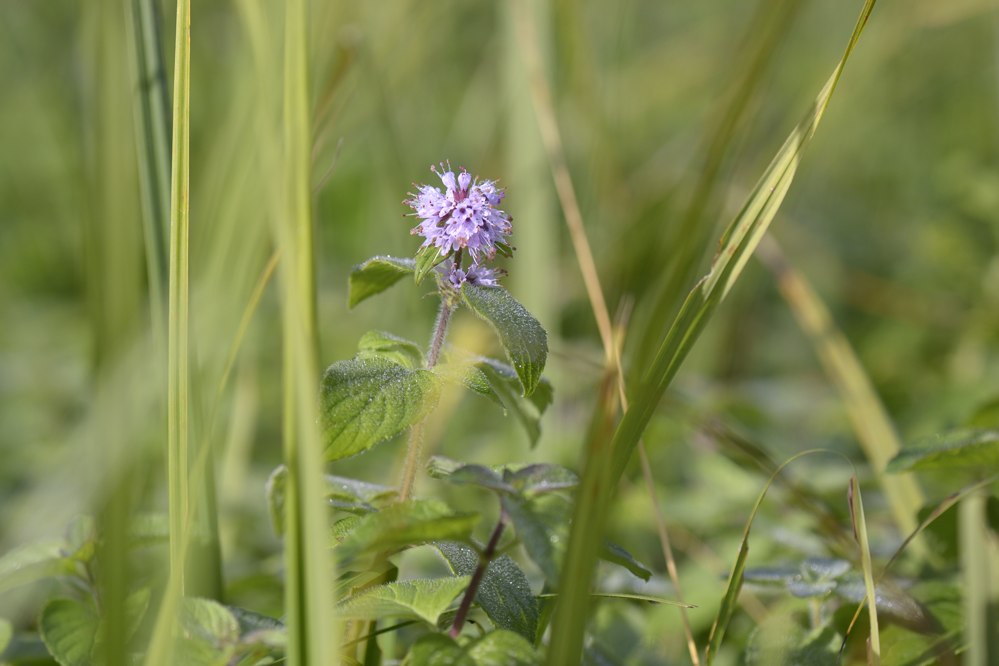
They grow in little mauve balls on top of the stems and also at the base of opposite leaves below it.


The plant has a mild mint scent that comes out when you walk over it. At least the leaves, the flowers smell subtly of honey.


In summer it is easy to find large many-stemmed tufts of Water Mint in wet meadows. Yes, butterflies love them.