The flora of Périgord in South-West France is abundant and diverse. In this blog you can find, in pictures, brief encounters with several hundreds of wild flowers and plants as they grow here in French Perigord. Following the seasons other species are added. An index of scientific and English names you find below on the right.

Corine Oosterlee is a botanist and photographer and she offers guided Botanical Walks and other activities around plants and vegetation in nature in Perigord. Do you want to know more? On www.baladebotanique.fr you can find more information. For Corine's photography see www.corineoosterlee.com. Both websites also in English.

Enjoy!


April 20, 2014

Exhibition


Exhibition 

"Photographies d'une naturaliste" 

from 2 May until 14 June 2014


In gallery Phi2 in Villamblard about thirty of my pictures are on show.
You'll find macro's, plant pictures and also some landscapes.
 -
Opening hours gallery: Friday and Saturday 10h-12h et 15h-18h, at all other times, please contact 06 82 81 13 74 (english spoken).
 -
 55 rue Gabriel Reymond
24140 Villamblard
Tel : 06 82 81 13 74


April 9, 2014

Violet Limodore


Strange purple asparaguses grow out of the soil. You find them in a dry oakwood with sparse trees, on dry calcareous soil, or even in a truffle orchard. What is it? A wild orchid, the Violet Limodore  (Limodorum abortivum).


From its underground rhizome new sprouts emerge. In a few weeks they will make large circles of deepn purple stalks carrying big purple flowers.


The flowers only open in really good weather. On dark and rainy days they do not open at all. Often the plant is cleistogamous, it pollinizes itself with its own pollen before the opening of the flowers. Sometimes the Violet Limodore makes flowers that don't even get above ground and never see daylight.

March 23, 2014

Rue-leaved Saxifrage


On an old stone wall grows between the mosses a very small reddish plant. It is the Rue-leaved Saxifrage (Saxifraga tridactylitis).


It has a short life, in a few weeks it has grown from seed, now it flowers and soon the seeds will disperse and after that the plant will die.  There are many such tiny plants. In the picture below you see on the same wall between three Rue-leaved Saxifrages another species, the Common Whitlow-grass (Erophila verna).


March 11, 2014

Blackthorn


The Blackthorn (Prunus spinosa) also has a mass of white blossom. Now the first buds open, well before the leaves.


The flowers of the Blackthorn are smaller as those of the Plum. They sit an nearly black branches. In autumn this bush produces small blue fruits.


Generally it is a bush of less than 1.50 m high. The Blackthorn is invasive, new branches develop from the spreading roots, and it can overrun a large surface. End of March edges of woods, hedges ant left-over pieces of land can be covered in white blossom like snow. The Blackthorn has - not surprising - big black thorns, and where they grow in dense stands they are literally inpenetrable.


March 9, 2014

Cherry Plum


The Cherry Plum (Prunus cerasifera) is the first of the Prunuses to flower.


This little tree is a cultivated species, but you find it quite often growing in the wild. It is often used as stock for fruit trees. Among the bushes that make hedges around fields and meadows, but also between the trees in a forest.


It flowers with a mass of pure white blossom. Every flower is pedunculated and has one stigma and about twenty stamen.


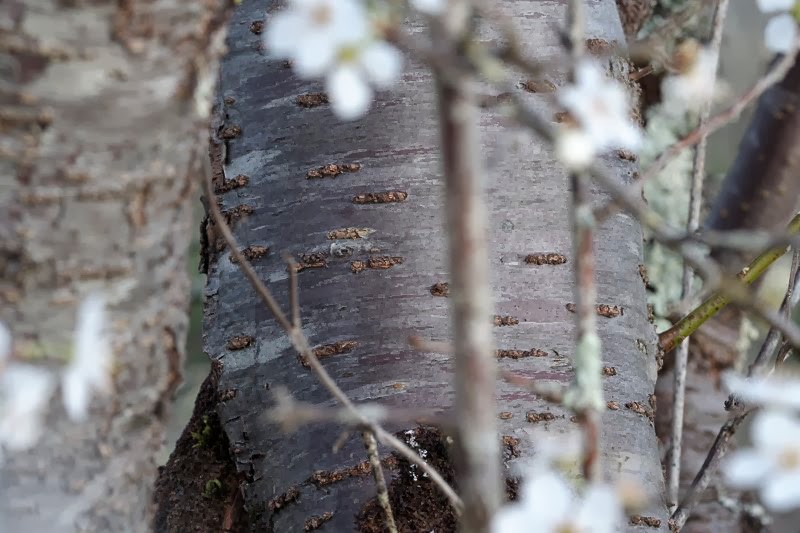
Like all Prunuses, the Cherry Plum has smooth greyish bark with slight horizontal stripes. In summer the little  plums appear, yellow, red or blue, round or oval, according to the subspecies. It is worthwhile to look out for a good tree. Sometimes the fruits are tasteless or sour, but in most cases they are sweet and perfumed.


March 7, 2014

Grey Willow

In March this bush is visible from far away. Before the leaves develop, the Grey Willow (Salix atrocinerea) covers itself in yellow catkins. Like most other Willows it needs water all the year round to flourish, so you will find it near a small stream, in a marshy forest or in a bog.


Here are the male catkins.


February 20, 2014

Dog Lichen


It is not a strange kind of moss, it is a lichen. Dog Lichen (Peltigera canina) is the result of a symbiotic relationship between a fungus and cyanobacter algae. It lives in woods, between mosses or on a rotting tree stump. This kind of lichens does not like dry weather, in summer it shrinks into something pale and grey. But in winther when it rains a lot it opens up and shows strong contrasting colours.


The blackish surface is the thallus, a mix of fungus mycelium and algae on the surface, exposed to sunlight. On this thallus grow the reddish brown apothecies that carry the fungus spores.