The flora of Périgord in South-West France is abundant and diverse. In this blog you can find, in pictures, brief encounters with several hundreds of wild flowers and plants as they grow here in French Perigord. Following the seasons other species are added. An index of scientific and English names you find below on the right.
Corine Oosterlee is a botanist and photographer and she offers guided Botanical Walks and other activities around plants and vegetation in nature in Perigord. Do you want to know more? On www.baladebotanique.fr you can find more information. For Corine's photography see www.corineoosterlee.com. Both websites also in English.
Enjoy!
May 21, 2017
Knotted Crane's Bill
Early this spring those leaves appeared in a wooded valley, under the trees near a small stream. Beautiful leaves, a bit shiny, on reddish creeping stems hidden under fallen leaves.
What plant is this? Difficult to say, especially when you see no flower. The leaves look a bit like those of Boston Ivy, but not exactly. Also Crane's Bill species can have this kind of leaves, only the plant does not look at all like other Crane's Bills known in Dordogne.
Some week laters, flower buds appeared.
And those really look like Crane's Bill buttons. But which one? Not that easy when there are no fruits and flowers that can help with identification. Some searches in floras and on the web result in Knotted Crane's Bill (Geranium nodosum) as a diagnosis; the plant has all caracteristics and also some particularities of this species.
Wait and see. There will be flowers.
They are a pale lavender-pink, with some purple stripes. Now there is less doubt, it really seems to be Knotted Crane's Bill.
Knotted Crane's Bill is a plant frow lower mountainous regions, and it has not been seen in Dordogne recently. It is sometimes found in the neighbouring Lot department, but it grows mostly in the lower reaches of Alps and Pyrenees. Perigord is not that mountainous. But the spot here, a shadowy not too dry valley on calcareous soil could match. Another possibility could be this is not a really wild plant but one escaped from a garden.
From where comes this plant? Does it grow here since a long time?
Is it possible it is a really wild plant, but that nobody has found it until now? Yes, it is an isolated spot and this is not exactly the kind of plant that jumps to the eye; the flowers are not that noticeable. No one ever comes here, except maybe hunters in winter.
Other rare plants thrive in this little valley, a sure sign you can find here a combination of environmental factors that is or has become rare. Like soil caracteristics, vegetation, (micro)climat), undisturbed-ness. It is possible this place has not been touched by developments (often under human influence) that changed habitats elsewhere, like plantations, changes in water quality, clearing, and that species could survive here.
Knotted Crane's Bill is cultivated as an ornamental plant since long, and Perigord has known a more dense population as today. This plant could have arrived with garden detritus, or grown from seeds from a garden plant, or even be planted long ago. Nearby there are ruins of an old water mill, and the stream has been managed in former centuries. If it is cultivated, you would expect other signs of human occupation, other cultivated plants. But here are none, so it is all speculation.
Whatever, Knotted Crane's Bill is here, and it is flourishing.
May 2, 2017
Yellow Dead-nettle
This picture is taken at the end of winter. Yes, Snowdrops were still in flower. And there were also some rather elegant reddish leaves.
What did become of them?
See here.
Now they brighten up this somewhat sombre woodland. The Yellow Dead-nettle (Lamium galeobdolon subs. montanum) made a lot of new green sprouts and now it is in full bloom. It likes a soil rich in humus, like here under the Hornbeams of a little wooded valley, not far from a stream. If it finds the right circumstances it is a good ground-cover plant, its creeping stalks can cover quite a surface.
The verticillate flowers are yellow, the upper lip clear yellow and the lower lip spotted with darker yellow.
April 17, 2017
Corn Rocket
Warm coulours on this meadow on acidic soil. It is not only the evening sun, but also plants growing here. Only a few years ago this meadow was a cultivated field, but now it is for making hay, and some plants typical for cultures are still here. In the background it is Sheep's Sorrel (Rumex acetosella), and in the foreground you can see the yellow flowers of Corn Rocket (Bunias erucago).
Let us look from nearby.
At first sight Corn Rocket looks like any kind of mustard or rapeseed or cress, or, why not, Rocket. A Brassicaceae with many branches and pale yellow flowers. The leaves are edible but there are not many, only a little rosette that disappears when flowering starts.
The flowers leave no room for doubt, yes this is a member of the Brassicacea family.
The fruits are rather special. They are covered with irregular points, and it is hard as a stone.
April 3, 2017
Pale Madwort
Those tiny yellow flowers grow in a rather arid limestone field.
Pale Madwort (Alyssum alyssoides) is an annual plant and it is one of the first to flower in this habitat. It lives in groups, sometimes there are hundreds of small plants dispersed over a few square meters.
When the flowers open you can see their four petals in the shape of a cross, typical for Brassicaceae.
You are lucky if you find it, it has become rare in Perigord.
The white flowers are not a different species, at the end of flowering the petals turn pale and stick to the developing fruit.
March 22, 2017
Annual Bluegrass
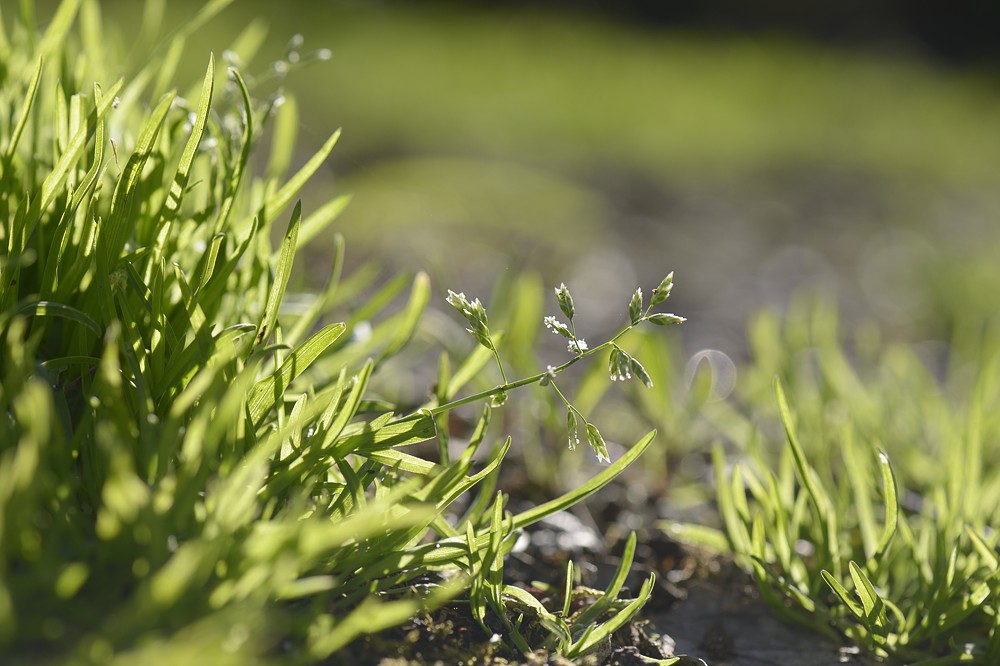
Annual Bluegrass (Poa annua) grows nearly everywhere and it flowers nearly all year round.
It is tiny so you have to look near your feet to see it. It is what you call an ordinary grass and it likes human presence where. It grows on sidewalks, between the pavement of a road, in forgotten corners of gardens and towns, around abandoned buildings, on walking paths. And also elsewhere.
The flowering stalks come out of a bunch of disorderly green leaves; those are slightly folded lengthwise.
Here, early in the morning, the flowers begin to open.
The small spikelets covered in dewdrops when opening, look more like a work of abstract art than like an inflorescence. The glumes, the small scarious scales that protect the spikelets are pink in this plant, bur often the plant is completely green, flowers included. Rhe stamens begin to get out, after a few hours they will release pollen in the wind.
March 21, 2017
Green Hellebore
The color of the Green hellebore (Helleborus viridis) justifies its name, it is really of an intense dark, green, green and you can see it when other plants do not yet show many green sprouts.
When wide open, you can see about twenty stamens and in their centre some pistils a bit longer.
Green Hellebore, here beside a fallen Hornbeam tree, looks very much like the other hellebore that grows in Dordogne, Stinking Hellebore, with paler flowers and a really bad smell. Green Hellebore is not as common as this species, you'll find it only in the deepest parts of valleys, under trees, and mostly not far from water.
March 11, 2017
Lawn Daisy
Everywhere on lawns and also elsewhere, Lawn Daisy (Bellis perennis).
Little radiant suns, a circle of pink-tipped ligulate flowers around a golden heart of tubular flowers.
A stem with a single flowerhead with typical hairs on the bracts.
And this stem comes out of a small basal cluster of leaves flat on the soil. Hoarfrost? No problem at all!
A bit of cold does not matter. The flower simply closes.
Here the flower in the rays of an end of the afternoon sun, beginning to close for the night.
Subscribe to:
Posts (Atom)