The flora of Périgord in South-West France is abundant and diverse. In this blog you can find, in pictures, brief encounters with several hundreds of wild flowers and plants as they grow here in French Perigord. Following the seasons other species are added. An index of scientific and English names you find below on the right.

Corine Oosterlee is a botanist and photographer and she offers guided Botanical Walks and other activities around plants and vegetation in nature in Perigord. Do you want to know more? On www.baladebotanique.fr you can find more information. For Corine's photography see www.corineoosterlee.com. Both websites also in English.

Enjoy!


September 17, 2017

Stiff Eyebright


Stiff Eyebright (Euphrasia stricta) is a little plant that grows in dry limestone meadows.


Now, at the end of summer, it has only a few flowers left on top of its stalks, the other flowers already fructified.


Midsummer in this flowery meadow it was still surrounded by its hosts, certain grasses and leguminose plants. Hosts? Yes, Stiff Eyebright is a hemiparasite, it has chlorophyll but it feeds also on the roots of other plants. Often around it you see grasses and other plants that are visibly smaller and less developed because of this hemiparasitism.


The flowers are tiny, purple-striped and with a yellow spot on the lower lip. Leaves and bracts toothed.


September 16, 2017

Burnet Saxifrage


They are everywhere now, the elegant umbels of Burnet Saxifrage (Pimpinella saxifraga). In limestone meadows and fields it flowers abundantly. It does not need a rich soil, and if it is dry and poor it is even better.


The upper parts of it are glabrous, with thin smooth stalks. There are only a few leaves on the stalks, if any, and they are deeply incised. The important leaves grow in a basal cluster at ground level. They disappear mostly when the plant flowers.


Here some basal leaves. You should think they belong to another species because they are so different, green and rather luscious. But no, it really is Burnet saxifrage.


And this is an umbel in fruit, its rays all have about the same length. Many Apiaceae - plants of the umbellifer family - have a ring of little leaves or bracts at the base of those rays, but Burnet Saxifrage has no involucre.


Autumn will arrive soon, but Burnet Saxifrage will go on flowering for a while.


August 30, 2017

Sheepbit


The picture here below dates from two weeks ago. Hot wetter last week brought flowering season for Sheepbit (Jasione montana) to an end, the little blue balls have faded away and now the plant is difficult to find. Especially when it hides in high grass and brambles.


The little round flowerheads are composed of several dozen very little bell-shaped flowers. Yes, Sheepbit is a member of the Campanulaceae family, it has also the typical blue colour of this family.


It grows in neglected grasslands and field and wood edges on sandy neutral or acidic soil, often in light shadow, and it is not that common in Perigord.


To carry so many flowers you need a lot of stalks, apparently.


August 15, 2017

Nettle-leaved Bellflower


A big, rather untidy plant grows in the brambles and bushes on the side of a path. It has a lot of blue flowers.


Nettle-leaved bellflower (Campanula trachelium) produces all summer, and even after it, blue or lilac bell-shaped flowers on long sturdy stalks. It does not like full sunshine so you will find it mostly in the shadow of trees, sometimes together with the Clustered bellflower that now already has stopped flowering.


The flowers are hairy, even inside!


The triangular leaves (yes, like nettle leaves) are also hairy. Here those of a small plant just before it started flowering.


July 20, 2017

Clustered Bellflower


Clustered bellflower (Campanula glomerata) is a species of woodland edges and roadsides. Here, it is hidden in the vegetation along a walking path; Oregano with its pink flowerheads is more striking.


The dark blue little bells grow in clusters along and at the end of the stems. Clustered bellflower begins to flower in June, and in August, it is over; it really is a summer flower.


Sometimes a flowerhead has only a few flowers, on big plants they are larger and fuller.


The leaves are rather long and heart-shaped at their base.


July 19, 2017

Square-stalked Saint-John's-wort


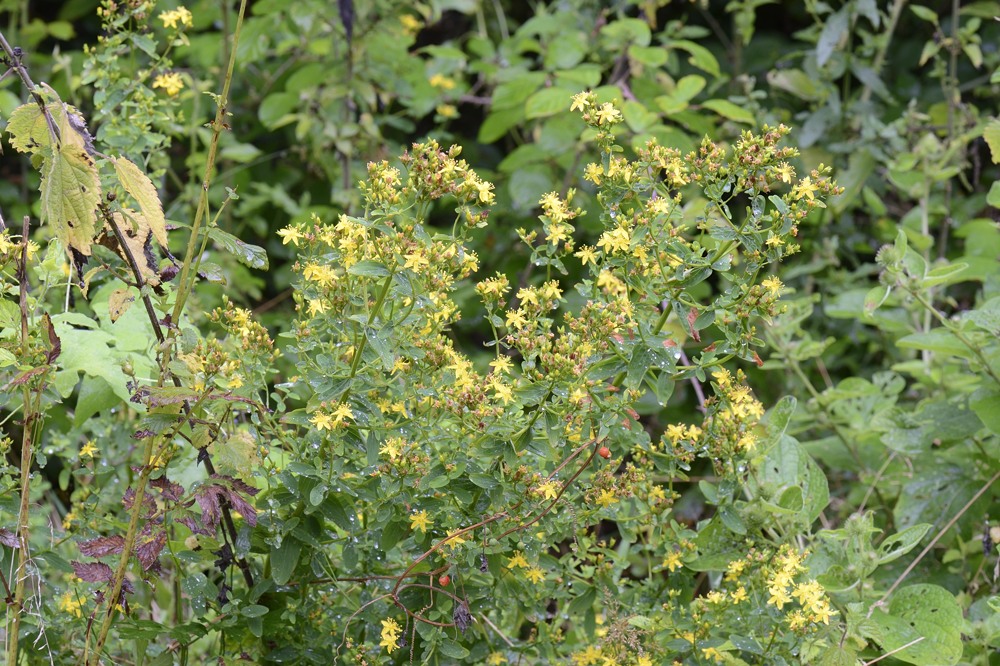
Square-stalked Saint-John's-wort (Hypericum tetrapterum) is prolific this summer, it has lots of flowers. It can grow nearly a meter high and it grows in marshy or swampy, or at least wettish, areas.


It has quadrangular stalks with distinct ridges. The leaves grow in opposite pairs and they are sessile. From most pairs of leaves emerge flowers.


In the leaves you can see tiny transparant points and sometimes also some small black points. They are just visible to the naked eye, a magnifying glass can be of help. The little black points are glands, and they are typical for hypericums. Square-stalked Saint-John's-wort does not have many of them compared to other species of this family.


The flowers are somewhat untidy little stars, five yellow petals and a bunch of stamens that go in all directions.


July 18, 2017

Lesser Scullcap


Not far from a the road that runs along a wet and slightly peaty area grows Lesser Scullcap (Scutellaria minor). It needs water and acidic soil to flourish and here, it finds both. In Perigord this kind of habitat is not very common, but in the open spaces of the Bessède forest you can find it. Flora here is very rich, and different from the plants you can find on dry Jurassic or Maestrichtian limestone soils that are more common in Perigord.


On the calyxes of the flowers of Lesser Scullcap grows, strangely enough, a kind of bump, whence its name. The little pink flowers are spotted with purple honey guides.